
Someone is missing on your team right now. Maybe a release date is fixed, a feature is supposed to open up a market, or there is a skill gap in the team that will not close by itself. An IT freelancer agency is supposed to solve that quickly. But how does such an agency actually work, what does it cost, and how do the providers differ?
This article walks through IT freelancer staffing step by step, using ElevateX as the example. Sören Elser, founder and managing director of ElevateX, also explains the process in the video below. After that, we compare the models on the market, without names but with their strengths and limits, and show what your procurement team wants to see before the first order. At the end, you will find a checklist of questions you can ask any agency, including us. The article is written from a German perspective: contracts and legal references follow German law.
What an IT Freelancer Agency Does
An agency stands between you and the freelancer, contractually too. As a rule, you sign the contract with the agency, and the agency signs its own contract with the freelancer. So you have one contracting party, and the invoices also come from the agency, not from the freelancer.
The freelancer remains self-employed. They are employed neither by the agency nor by you and organize their work themselves. That is what separates freelancer staffing from employee leasing (Arbeitnehmerüberlassung): there, a provider with a permit under Section 1 of the German Act on Temporary Agency Work (AÜG) (in German) leases out its own employees, who work under your instructions, as a rule for no more than 18 consecutive months. Our comparison of employee leasing and freelancers explains which form fits when. It also differs from recruitment for permanent positions: there, you end up employing the person yourself.
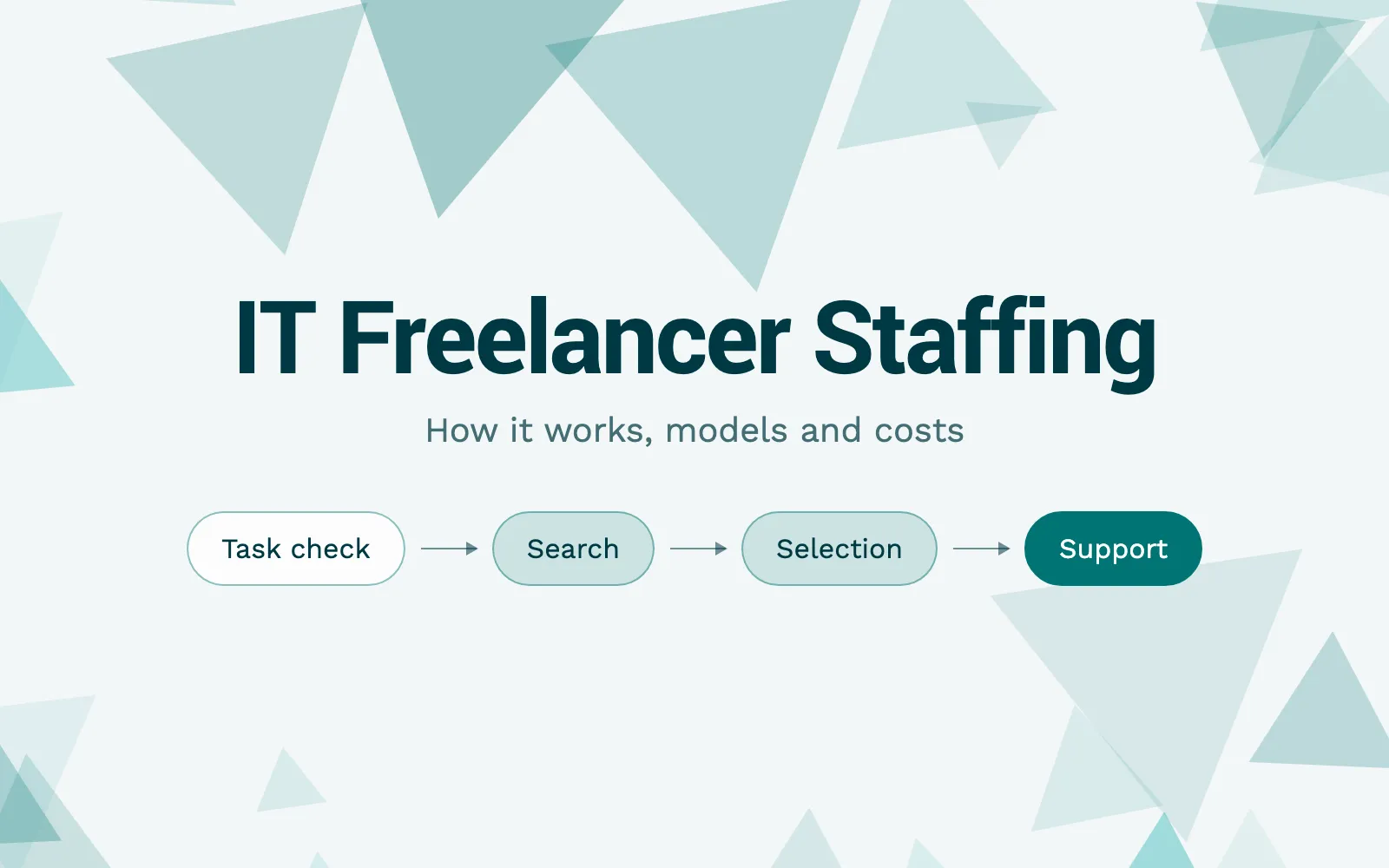
How an IT Freelancer Agency Works: The Process in Four Steps
The details of the process differ from provider to provider. We describe it the way it runs at ElevateX. In the video, Sören explains the four steps in just under nine minutes. The video is in German, and you do not need to watch it to follow the text: everything important is written below.
1. Task Check: First the Task, Then the Person
A request usually names a few keywords: programming language, framework, seniority. But these keywords decide only a small part of whether an assignment succeeds. At least as important: does the request really describe what is needed? Which points matter how much? And what has to fit on a personal level? If that is not clear, you later get a perfect answer to the wrong question. Sören compares it to an unclear ticket from the backlog that gets built anyway: clean, on time and beside the point.
That is why working with ElevateX begins with a task check. After your request, Sören calls you, and the conversation usually takes 10 to 20 minutes. He does not start with keywords but with your project: what are you building, where are you stuck, what do you stand for as a company? He adds one or two questions about the team. How do you work together? And who moves you forward: someone who gets things started, or someone who works through tasks cleanly? If your request already contains concrete details, Sören checks ElevateX’s own database before the call.
At the end of the call, you get an honest assessment. If Sören cannot find anyone for you, he tells you so right there. For you, this means you explain your project exactly once. From the moment your request has been finalized, the clock is running: within 48 hours, you receive the first matching profiles.
2. Search: Conversations Instead of Keyword Search
Even when the requirements are clear, the search can still miss, namely when it ends up being a keyword search after all. By his own account, Sören could send you ten matching profiles from a keyword search within half an hour of the phone call. “That’s not the hard part. The hard part is finding the one who really fits.”
So the search starts where there is experience with the people: in ElevateX’s own pool, through recommendations from other freelancers and among people Sören knows from earlier projects. Then he picks up the phone and, in this phase, talks to a great many freelancers. The most important question is: what exactly did you build, and which problem did you solve with it? Anyone without a concrete answer is out, no matter how good the CV looks. Sören personally speaks with every freelancer whose profile you later receive.
One point is often underestimated: good freelancers have a choice. Winning a decent freelancer with the right skill is rarely hard. Winning the really good ones is. So the match has to work in both directions: what can the freelancer do for you, and what does your project offer them? That is exactly why Sören asks in the task check what you are working on and what you stand for. It lets him explain your project to the right people in a way that makes them want to do it.
3. Selection and Intro Calls: Few Profiles, a Clear Recommendation
Instead of a stack of CVs, there is a short call. In it, Sören presents up to three freelancers: with his impressions from the conversations, a clear recommendation and the CVs. Each profile comes with an hourly rate that includes everything. Sören describes it as a sommelier who does not bring you the whole wine list but three bottles that go with your meal. You do not sort, you choose.
After that, you usually have one or two favorites. Sören organizes the intro calls with them. In the video, he compares it to a test drive: you talk to the person yourself, ask your questions and notice whether the chemistry is right. The decision is yours.
If none of them fits one hundred percent, you take none. “Better no one than the wrong one,” says Sören. In that case, his work costs you nothing, and you are free to decide whether he keeps searching. As a rule, though, in his experience at least one proposal from the first selection hits the mark.
After that, things move quickly if your side keeps up. If the client cooperates well, Sören considers it realistic that a freelancer is ready to work within a week or less. What slows things down is mostly processes, approvals and signatures in your own company. How to prepare for that is covered in our article on hiring freelancers, in the section “From Request to First Working Day.”
Before the Start: Contract, Checks, Confidentiality
At ElevateX, you sign a project contract with ElevateX, and ElevateX signs a project contract with the freelancer. This contract has features of both a service contract and a contract for work but is essentially closer to a service contract. What you should cover in a freelance contract is explained in our freelancer contract guide.
Before the project starts, every freelancer receives a questionnaire on false self-employment. Among other things, it clarifies whether someone works alone or with staff, which insurance they have, whether they bear entrepreneurial risk, whether they were employed by the same client in recent months and whether they serve other clients. What you need to watch out for yourself is covered in the guide to false self-employment.
Confidentiality is covered in the regular contract. For some projects, ElevateX signs a separate confidentiality agreement with the freelancer before the first conversations. For assignments through ElevateX, the rights to the code belong to the client.
If your procurement team has a say, you will find further down what it wants to see and how long supplier onboarding takes.
4. Support: Check-ups During the Assignment
An agency’s work should not end when the freelancer starts. If something goes wrong during the assignment and nobody asks, it is noticed late. And if a new contact starts from zero on the next search, you explain all over again who you are and how you work.
That is why Sören holds regular check-up calls on every assignment, with you and with the freelancer. From these conversations in more than 500 successful projects, he knows the patterns an assignment depends on. He passes three of them on to clients:
- Give the freelancer three clear goals for the first 14 days.
- Access and the working environment must be ready on the first day.
- Name a fixed technical contact in the team.
You can read more in our guide to freelancer onboarding.
If a problem does come up, it is solved early because you are talking regularly anyway. And with every conversation, Sören understands your team a little better. That makes the next search more accurate, because he no longer has to ask how you tick. On average, freelancers work on assignments through ElevateX for ten to eleven months, and 95 percent of clients engage ElevateX more than once.
Which Models Exist on the Market
There are several ways to find IT freelancers. The models differ less in what they promise than in how the work is divided: who searches, who makes the shortlist, and how much work stays with you? Speed alone hardly shows the difference anymore. Many providers now promise first profiles within 48 hours or less, from matching platforms to large staffing firms. What matters is what happens before those 48 hours.
Project Boards and Marketplaces: You Search Yourself
You post your project or browse profiles, freelancers apply, and you make the choice yourself. You usually sign the contract directly with the freelancer. For clients, this is often cheap: depending on the portal, you pay nothing, a fee for the listing or for access, or a commission per job. In return, reviewing profiles, interviews, the contract, checking self-employment status and invoicing are all up to you.
- Fits if you have experience with freelancers, bring time for reviewing and want to compare many profiles.
- Limits: Applications come in quickly, but you do the sorting. The time you save on the search goes into the selection.
Which platforms exist and how open and closed portals differ is shown in our comparison of freelance platforms.
Matching Platforms: A Shortlist From a Large Pool
Matching platforms vet freelancers when they join, for example with technical tests or interviews, and suggest profiles that match your request. The pool is often international, and the work is frequently remote and in English. Contract and invoicing run through the platform, usually at an hourly rate that includes its fee. Some platforms require a minimum number of hours per month.
- Fits if the task is clearly defined, works remotely, and language, time zone or on-site presence do not matter much.
- Limits: Ask who selects the suggestion for your specific task and whether anyone has spoken to the freelancer about your project. If you need German skills, on-site days or a good fit with the team, raise that up front.
Large Staffing Firms: Many Roles, Many Routes
Large staffing firms, also called personnel service providers, often cover several routes: freelancer staffing, employee leasing and recruitment for permanent positions. They work with large databases and several teams. The client conversation and the search are often handled by different people, for example in sales and in recruiting. For freelancers, billing is through an hourly rate with a markup. For employee leasing, it is through a billing rate.
Sören knows this model from the inside: before founding ElevateX, he worked at one of the large German agencies for IT freelancers, first as a key account manager, later as a team lead. He tells his story on our About us page.
- Fits if you want to fill many roles in parallel, your procurement team only works with suppliers that are already listed, or you need employee leasing because someone is supposed to work under your instructions.
- Limits: Where conversation and search are separated, a lot depends on the handover. Ask who looks after you, who searches and who has personally spoken to the candidates.
Personal Agencies: One Person From Request to Assignment
At a personal, often founder-led agency, one person holds the conversation with you, searches, talks to the freelancers, presents them and stays involved during the assignment. The pool is smaller and relies on contacts, recommendations and earlier projects. Billing is usually through an all-in hourly rate. This is how ElevateX works.
- Fits if you have little time for reviewing profiles, the task demands more than a list of skills and you want a fixed contact who knows your team.
- Limits: One person’s capacity is limited, and a lot depends on them. Ask how many searches are running in parallel and who covers if that person is unavailable. A smaller pool does not cover every niche. A good personal agency tells you that in the first conversation. In addition, there is usually only one model: ElevateX only places freelancers and does not offer employee leasing.
Software Agency or Nearshore Team: You Buy a Result
A software agency or a nearshore team takes over an entire project, usually with its own project management. You buy a result or a team, billed at a fixed price or by time and materials. The team works largely on its own, often at a different location.
From his own practice, Sören sees it like this: nearshoring can make sense if you have a clearly self-contained topic, such as a complete app that has to do certain things. Or if you have the capacity to lead a team that sits a few hundred or a thousand kilometers away. If, on the other hand, you have your own team and want to strengthen it selectively with individual specialists, then for him, working with freelancers is “the much faster, more efficient and usually better way.”
- Fits if you want to hand over a self-contained project completely and your team does not have to develop it further itself.
- Limits: The knowledge builds up outside your team, and coordinating over a distance costs management time. More on this in our article on nearshoring and offshoring.
The Models at a Glance
| Model | Who makes the shortlist? | Billing | Fits if … |
|---|---|---|---|
| Project board, marketplace | you do | free, a fee or a commission, depending on the portal; contract directly with the freelancer | you have time to review profiles |
| Matching platform | the platform suggests, you decide | hourly rate including the platform fee | the task is clearly defined and works remotely |
| Large staffing firm | a recruiting team suggests, you decide | hourly rate with a markup; billing rate for employee leasing | you fill many roles, use supplier lists or need employee leasing |
| Personal agency | one person talks to everyone and suggests a few, you decide | all-in hourly rate | you have little time and team fit matters |
| Software agency, nearshore team | the agency provides its team | fixed price or time and materials | you want to hand over a self-contained project |
When a Freelancer Agency Is Not the Best Choice
A good agency also tells you when another route fits better. From Sören’s practice, there are four cases:
- You have time to review profiles: If you can write the job post yourself, review a large number of profiles and bring people into the team on your own, you can also do this through a platform.
- The task purely follows instructions: For tasks such as an IT service desk, where someone regularly works through instructions from the client, Sören advises using an employee-leasing provider rather than a freelancer.
- You want to hand over a self-contained project: Then a software agency or a nearshore team can fit.
- You lack a stable core: If technical and domain knowledge has to stay in the company for the long term, you need permanent employees for that. Freelancers complement this core. They do not replace it.
From practice: Recently, Sören had a client where more external freelancers than internal employees were working. The client needed people who form the core of the team for the long term and keep the technical and domain knowledge of the project. Sören clearly advised him to look for permanent employees in addition to the freelancers and to build a stable core.
What Does an IT Freelancer Agency Cost?
With freelancer staffing, you usually do not pay a fixed fee for the search but an hourly rate that includes the agency’s work. The agency uses it to pay the freelancer and cover its own work: search, conversations, contract, invoicing and support. Its share is a matter of negotiation and hard to see from the outside. More important for your decision is what the rate includes and what comes on top. The other models bill differently: portals through fees or commissions, software agencies at a fixed price or by time and materials, employee-leasing providers through a billing rate.
How an agency finds the price between the client’s budget and the freelancer’s rate is described by Sören in our article on the freelancer hourly rate. Typical market rates for IT freelancers are in the guide to freelancer costs.
How ElevateX Bills
- All-in hourly rate: Every profile comes with an hourly rate that includes everything. There are no additional fees. For software freelancers, this all-in hourly rate for the client is usually between €105 and €125.
- Free before the start: Search, conversations, profiles and intro calls cost you nothing. Costs only begin on the first working day.
- If no one fits, you pay nothing: If none of the proposals fits, Sören’s work costs you nothing, and you decide whether he keeps searching.
- Billing by the hour: Only the hours you have signed off are billed. The first invoice comes after the first month, for the work actually done.
- One invoice per assignment: In the video, Sören puts it briefly: “One invoice a month.” To be precise, the standard is one invoice per freelancer assignment, that is, a separate invoice for each person working for you. If you have several freelancers and want only one consolidated invoice per month, ElevateX sets that up on request.
- No commitment: There is no minimum term and no minimum volume. If it does not work out after all, an assignment can end from one day to the next. You keep the results produced up to that point, and a new search costs you nothing.
What to Compare the Costs With
Calculated per day, a freelancer can be more expensive than a permanent employee. Sören says so openly. Still, for him the day rate is the wrong number to compare: you are not buying a day, you are buying a result. So factor in:
- your own time: Every hour your team puts into reviewing profiles and interviews is missing from development.
- the cost of an open position: According to a 2025 Bitkom survey (in German), it takes 7.7 months on average to fill a vacant IT position in Germany. How to turn that time into money is shown in our article on time to fill.
- the result: A case from Sören’s practice, in which a senior freelancer rescued a release in four weeks, is described in the cost guide.
With our freelancer and employee cost comparison, you can run the numbers with your own figures. For Sören, though, the question behind it is not freelancer instead of permanent employee: “It’s not an either-or.” In his view, a freelancer is the right choice where a task needs a result at short notice, meaning someone would have to be working on it within two to four weeks.
When Procurement Gets Involved: Supplier Onboarding and Documents
So far, this article has been about you as the department that needs the freelancer. In some companies, someone else has a say as well: procurement. How much depends, in Sören’s experience, mainly on the size of the company. There is no single process that applies to all clients.
When Procurement Has a Say at All
Smaller companies with up to around 500 employees often have no procurement team that wants a say when it comes to freelancers. There, a lot runs directly through the department. At ElevateX, in Sören’s experience, that is even “the more common case.”
If procurement does get involved, it is normally about negotiating the contracts in detail. There are two ways to do that:
- ElevateX’s templates: If your company has no contracts of its own for freelancer assignments yet, ElevateX’s standard templates serve as the basis.
- Your own contracts: If your company already knows the model and works with freelancers more often, negotiations are based on your own framework agreements and contract templates.
What Procurement Wants to See
Especially at large corporations, the topics are often the same in Sören’s experience:
- Proof of insurance: business liability insurance for IT and software development that covers suitably high amounts of damage
- Master data: the complete details needed to set up a supplier in the system
- References: sometimes the question of which clients of a similar size or from a similarly security-sensitive environment ElevateX already works with
Which Documents You Get on Request
ElevateX has no fixed document package for procurement, because negotiations with procurement do not happen that often. If your company brings procurement in, you get these documents on request:
- a sample project contract
- proof of liability insurance
- the questionnaire on false self-employment
- documents on data protection
- references
How Long Supplier Onboarding Takes
According to Sören, that depends above all on how much pressure there is in your company. Two reference points from his experience:
- Two to three days when it is urgent: There have been cases in which the department needed freelancers immediately to keep a project going. Internal champions then made sure that ElevateX was set up in the client’s system after two to three days and the client could place orders.
- Four to six weeks without time pressure: If supplier onboarding runs in advance and without urgency, that is, before there is a concrete request, expect this time frame.
For you as the department, this means: find out early whether your procurement team first has to set up a new supplier, and look for someone in the company who pushes the process along. Otherwise the profiles are on the table and the start depends on supplier onboarding.
Together with the steps above, this gives you the following timeline:
| Step | How long it takes |
|---|---|
| Task check by phone | usually 10 to 20 minutes |
| First matching profiles, up to three | within 48 hours after your request has been finalized |
| Supplier onboarding, if your procurement team requires it | two to three days when it is urgent; four to six weeks without time pressure |
| Freelancer ready to work | in Sören’s experience realistically within a week or less, if the client cooperates well |
Checkpoints for Procurement
Your procurement team should clarify these points before it approves an agency. Next to each one, you can see how ElevateX handles it.
| Checkpoint | Question for the agency | How ElevateX handles it |
|---|---|---|
| Contracting party | Who do you sign the contract with, and what kind of contract is it? | You sign a project contract with ElevateX, and ElevateX signs its own with the freelancer. It is essentially closer to a service contract. ElevateX does not offer employee leasing. |
| Contract basis | Do the agency’s templates apply, or your framework agreements? | Both are possible: ElevateX’s standard templates or your own framework agreements and templates. |
| False self-employment | How does the agency check that a freelancer works as a self-employed person? | Every freelancer receives a questionnaire on false self-employment before the project starts. |
| Confidentiality | Is it part of the contract, or does it need a separate agreement? | It is covered in the regular contract. For some projects, there is a separate confidentiality agreement with the freelancer in advance. |
| Rights to the results | Who owns the code? | The rights to the code belong to the client. |
| Liability and usage rights | Which clauses are open for discussion? | In Sören’s experience, clients usually want to change little. Most often, liability is discussed again and adjusted, and now and then there are questions about usage rights. |
| Data protection | Does the freelancer get access to personal data, and how is that regulated? | There is no contract on the processing of personal data by default, because not every freelancer works with such data. If they do, ElevateX normally makes one agreement with the client and one with the freelancer. Large corporations often handle this with their own standard contracts directly with the freelancer. |
| Invoicing | How many invoices do you get, and for what? | The hours you have signed off are billed. The standard is one invoice per freelancer assignment. On request, there is one consolidated invoice per month. |
| Price | What does the hourly rate include? | An all-in hourly rate with no additional fees. |
| Term and ending | Is there a minimum term, a minimum volume or a notice period? | No minimum term, no minimum volume. An assignment can end from one day to the next, and the results stay with you. |
You can read more about the individual points in our guides to the freelancer contract, to false self-employment and to data protection with freelancers. How the hourly rate comes about is covered above in the section on costs.
Legal position as of November 2026, based on German law. The information on contracts, employee leasing, false self-employment and data protection gives an overview and describes how ElevateX handles these points. It is not legal advice.
How to Recognize a Good Freelancer Agency
You cannot tell whether an agency works well from its website, but you can from its answers. You can ask any provider these eleven questions. Our own answers are included with each one.
- Who holds the first conversation, and who searches? If conversation and search are handled by different people, a lot depends on the handover. Ask how your briefing reaches the person who searches. At ElevateX: Sören does both.
- Has someone personally spoken to every freelancer who is proposed, and about what? A CV shows positions held but not a solved problem. At ElevateX: Sören personally speaks with every freelancer whose profile you receive and asks what they have actually built.
- What does the agency ask you before it searches? Does it only ask about skills, or also about the task, the team and the way you work? At ElevateX: The task check is about your project, about what is stuck, what you stand for and how you work as a team.
- How many profiles do you get, and with what recommendation? Many profiles shift the work to you. At ElevateX: up to three, with a clear recommendation and an hourly rate for each profile.
- When does the clock for the profiles start? Ask whether it counts from your request or from the briefing, and what comes after. At ElevateX: The first matching profiles arrive within 48 hours after your request has been finalized.
- What does it cost before the start, and what if no one fits? At ElevateX: nothing. Costs only begin on the first working day.
- Is there a minimum term, a minimum volume or a notice period? At ElevateX: no minimum term and no minimum volume. An assignment can end from one day to the next.
- Who is your contracting party, and how is false self-employment checked? Also ask who owns the rights to the results. At ElevateX: You sign a project contract with ElevateX, every freelancer fills in a questionnaire before the project starts, and the rights to the code belong to the client.
- What happens after the start? Ask who gets in touch and how often. At ElevateX: regular check-up calls with you and with the freelancer, on every assignment.
- Does the agency also tell you when it cannot help? An honest no saves you weeks. At ElevateX: You hear that in the very first conversation.
- What evidence is there? Ask for references, repeat business and success rate. At ElevateX: more than 500 successful projects, less than 1 percent of assignments not successful, 95 percent of clients engage ElevateX more than once, and around 75 percent of requests come about through recommendations. One reference is the DKB Code Factory.
Conclusion
How well an IT freelancer agency works shows in four places: how thoroughly it understands your task, how it searches, how few and how well-reasoned the profiles are that it presents, and whether it stays available after the start. Which model suits you depends mainly on your time and on the kind of task. You can review profiles yourself on a portal, have a platform suggest people, cover many roles with a large staffing firm, work with a personal agency or hand a project over to a software agency.
Whichever route you choose: waiting too long costs. “I don’t know a single CTO who brought in outside help too early. Only too late,” says Sören. For him, help in week ten is like an umbrella you open when you are already wet.
FAQs
What does an IT freelancer agency do?
What does IT freelancer staffing cost?
How fast can I get a freelancer through an agency?
Platform or agency: which fits better?
How do I recognize a good freelancer agency?