
In Germany, recruiting a skilled worker from the external labor market costs companies around €13,700 on average. Only about €1,600 of that is spent before the contract is signed; the rest goes into onboarding. That is the finding of the latest cost-benefit survey by the Federal Institute for Vocational Education and Training (BIBB).
Which of these numbers is your cost per hire depends on the definition. This article shows how to calculate the metric under the most widely used standard, works through an example from IT, gives you benchmarks and explains what the metric deliberately leaves out.
What Is Cost per Hire?
Cost per hire (CPH) is a recruiting metric. It measures what it costs on average to fill an open position with a new person.
The most widely used definition is the US standard ANSI/SHRM 06001.2012, approved by the American National Standards Institute in February 2012. The international version, ISO/TS 30407:2017, last confirmed in 2024, has the same purpose: to measure the economic value of the effort it takes to fill an open position. In ISO 30414, the standard for human capital reporting (second edition 2025), costs and recruitment are among the reporting areas.
The standard draws tight boundaries. The metric covers the costs of sourcing, selecting and hiring, not what comes afterwards: no salary, no training, no losses from staff turnover and not the time it takes the new person to become fully productive.
Two more points from the standard matter in practice. First, only hires on your own payroll count. The standard explicitly excludes freelancers, agency staff and consultants. Second, the authors warn against driving the number down without regard to whether the organization can still attract good people. That, they note, has generally proven harmful.
How to Calculate Cost per Hire
Cost per hire = (external costs + internal costs) / number of hires in the period
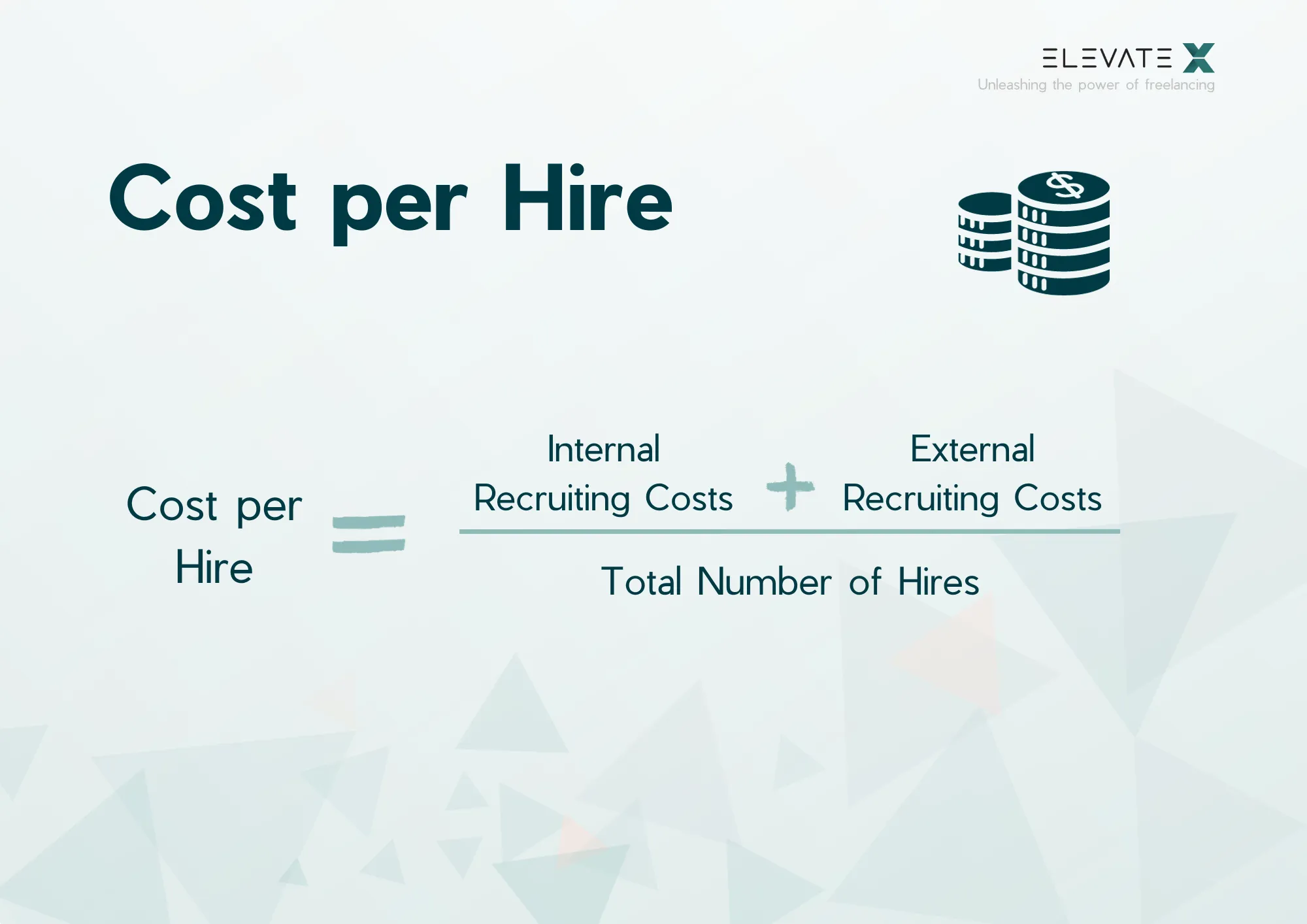
External costs are paid to third parties; internal costs come from your own people and infrastructure. The standard lists these items, among others:
| Cost type | Examples |
|---|---|
| External | Job ads and job boards, recruitment agencies and search firms, recruiting events, pre-hire screening, travel costs for candidates and recruiters, relocation, sign-on bonuses, employee referral awards |
| Internal | Recruiting team with all personnel costs, interview time of managers and the team (number of interviews times an internal rate), applicant tracking system, training for the recruiting team, a share of office costs |
To make the number meaningful, settle three things:
- The period: a quarter or a year. Costs and hires come from the same period.
- What counts as a hire: the accepted offer or the first working day. The standard allows both. If you count starts, you measure the cost of successful hires. Stick to one method.
- The groups: Analyze by type of role and by channel. According to the standard, costs vary widely by position, level, market demand and region.
To compare very different roles, the standard also defines the recruiting cost ratio: total hiring costs divided by the new hires’ total first-year pay, times 100. The result shows how many cents you spend on hiring per euro of annual pay.
Example From IT
A software company hires four developers in one year, each with an annual salary of €70,000. The amounts are assumptions for the example, not market figures. Only the agency fee follows the BDU average.
| Item | Type | Amount |
|---|---|---|
| Job ads and job boards | external | €4,000 |
| Search firm for one position (27.5% of €70,000) | external | €19,250 |
| Travel costs for candidates | external | €750 |
| Recruiting: one fifth of a position with €80,000 fully loaded cost | internal | €16,000 |
| Interview time of the team: 60 hours × €75 | internal | €4,500 |
| Applicant tracking system, pro rata | internal | €1,500 |
| Total | €46,000 |
Cost per hire = €46,000 / 4 = €11,500
The recruiting cost ratio is €46,000 / €280,000 × 100 = 16.4 percent. And the single position filled through the search firm accounts for just over 40 percent of total costs. That is why it pays to look at each channel: the average alone hides which route is expensive.
Cost per Hire Benchmarks
USA: The HR association SHRM reports an average of $5,475 per nonexecutive hire for 2025, and $35,879 per executive hire (survey of 2,371 SHRM members, January to March 2025). Because pay levels, channels and fees differ, these figures are only a rough guide for other countries.
Germany: We have not found a current survey that reports cost per hire for German IT roles under exactly this definition. The most robust source for Germany is the BIBB cost-benefit survey (in German; BIBB Report 2/2025, data from 2022/2023). It records the recruitment costs for the most recently hired skilled worker at 2,668 companies that had hired skilled workers from the external labor market since 2020:
| Cost type | Average per skilled worker |
|---|---|
| Application process (ads €656, staff time for selection €507, external consultants €414) | €1,577 |
| Training during onboarding, mostly training by colleagues (€6,448) | €7,643 |
| Lower output during the onboarding period | €4,468 |
| Total | €13,689 |
Under the standard’s narrow definition, the application process comes closest to cost per hire: €1,577. Almost 90 percent of the costs arise after the contract is signed. Further findings:
- The distribution is skewed: At half of the companies, costs were below €5,700.
- Larger companies pay more: Micro businesses came to €12,345, large companies with 500 or more employees to €21,386.
- Costs are rising: Since the 2012/2013 survey, recruitment costs have risen by 65 percent.
The figures apply to skilled workers in vocational occupations across all industries, not specifically to IT roles or university graduates. The frequently quoted figure of €4,700 per hire comes from the same survey series but is based on data from 2007 (Muehlemann and Pfeifer, IZA 2013).
Search firms in Germany: If you bring in a search firm, its fee is usually the biggest single item. According to the German consulting association BDU (in German), it averaged 27.5 percent of the position’s target annual pay in 2024 (study “Facts & Figures zum Personalberatungsmarkt 2025”, almost 200 firms). For a target pay of €80,000, that is €22,000. The survey covered firms that work on an exclusive basis and mostly on retainer, with installments paid regardless of the outcome. According to the follow-up study from April 2026 (in German), fee levels and structures have not changed fundamentally.
What Cost per Hire Leaves Out
The metric is deliberately narrow. For a decision, you need the items next to it:
- Onboarding: In the BIBB survey, it is the largest block. What a well-prepared start looks like is shown, using external specialists as the example, in our guide to freelancer onboarding in six steps.
- The vacancy: As long as nobody does the work, the open position costs money. How to estimate that is covered in our article on time to fill, with the cost of vacancy formula by Sören Elser, founder and managing director of ElevateX.
- The length of the selection process: Where the process gets stuck and how to speed it up is covered in our article on time to hire.
- Salary, benefits and turnover: These are ongoing costs. The standard explicitly excludes losses when someone leaves early.
If you only push down cost per hire, it is easy to save in the wrong place.
How to Reduce Cost per Hire Without Cutting the Wrong Corners
- Measure by channel: job ads, referrals, network, search firms. Only then can you see which route makes a hire expensive.
- Define the task before the ad goes live: Separate must-haves from nice-to-haves. Every unclear requirement costs interviews.
- Bundle interviews and decide quickly: Your team’s interview time counts as an internal cost.
- Use internal routes: Referrals and internal candidates save ad and agency costs. The pros and cons are compared in our article on internal and external recruiting.
- Use search firms selectively: for roles where other routes don’t work.
- Track quality too: The standard itself notes that the metric says nothing about the quality of a hire, the time to fill or how satisfied managers and candidates are.
Where the Math Is Different With a Freelancer
A freelancer is not a cheaper substitute for a hire. Sören sees freelancers “much more as a strategic resource” alongside the permanent team: “it’s not an either-or.” Still, the math is different in three places:
- No hire, no cost per hire: The standard does not count freelancers as hires. Through ElevateX, the search is free. You pay an all-in hourly rate for the hours actually worked.
- Costs start on the first working day: The first invoice comes after the first month, for the work actually done. There is no minimum term.
- A result within weeks: Sören recommends a freelancer “whenever it’s a task that needs a result at short notice”, meaning someone should be working on it within two to four weeks.
In return, the ongoing rate is higher. “Sure, the day rate looks higher,” Sören writes on LinkedIn. What a freelancer costs a company is covered in our price guide for hiring freelancers.
In practice: The most common objection from new clients is price. Sören answers with a question of his own: “I always ask first what they’re comparing it with.” Usually the answer is a permanent employee. “And you quickly get to the point where these are simply two models that can’t be compared. Because in the situations where a client really needs a freelancer, they normally need someone who can start tomorrow.”
If you still want to compare, include everything that comes with a permanent position. In one post, Sören lists recruiting, onboarding, social security contributions, vacation, sick leave, idle time, internal overhead and notice periods. Set these against the freelancer’s hourly rate for the time the task actually takes. Or, as Sören writes: “do the math yourself.”
Sometimes both run in parallel. By Sören’s estimate, roughly 20 to 25 percent of placements through ElevateX start this way: the client is actually looking for a permanent employee but needs someone who can get going much faster, and keeps searching for the permanent hire in parallel. In Sören’s experience, such a bridge lasts four to six months on average. The cost per hire for the permanent role still applies, but the work does not pile up in the meantime. More on this in our article on time to fill.
Sören also recommends permanent hires. Recently, he clearly advised a client whose team had more external freelancers than internal employees to also look for permanent staff and build a stable permanent core. The client needed people who would stay with the team long term and keep the technical and project knowledge in-house. Or, as Sören puts it on LinkedIn: “Sometimes a permanent employee is the better fit. Sometimes a freelancer. Or both.”
Conclusion
Cost per hire measures what the search up to the hire costs: external plus internal costs, divided by the number of hires. Fix the period and the counting method, analyze by channel and type of role, and only compare figures based on the same definition. The bigger items often sit next to it: onboarding, the vacancy and the length of the selection process. If a task needs a result within weeks, a freelancer can take it on alongside the permanent team while the search for a permanent hire continues.
FAQs
What is cost per hire?
How do you calculate cost per hire?
What does a hire cost in Germany?
How much does a recruitment agency charge?
What is not included in cost per hire?