

Technological progress requires professionals who are familiar with digital structures and are already working on tomorrow’s standards. Working with specialized software that keeps evolving, for example, requires up-to-date expertise. This is where freelancers come in: they focus on a specific job and stay up to date. They are in particular demand when a company has to handle specialized tasks its own team was not trained for.
Are you looking for the right freelancer for your company? Or are you a freelancer looking for a client with an exciting project? We explain how open platforms, closed platforms and agencies differ, introduce well-known platforms and help you choose.
Why Freelancers Are In Demand
Digitalization is making its way into more and more business processes. This creates challenges, because it often involves specialized applications for which the existing team is not trained. This is where freelancers come in. They are specialists who work for a company on a temporary or project basis without being employed.
Freelancers usually have very specific knowledge, which makes permanent employment a poor fit for them. They focus on specific work steps or projects. Once these are completed, a company would have to deploy them on other tasks that have nothing to do with their specialization.
Specialized knowledge is more and more in demand, because the world of technology consists of many work steps that differ in nature and still have to fit together. If you work as a freelancer, you probably like to pick a specific field and perfect your skills in it. Being an employee holds no appeal for you. You prefer to specialize in one subject area and offer these skills as a service. That is useful and lucrative, because digital vocational training can’t be created at the speed and complexity at which technology develops and changes.
Freelance Platforms From A Freelancer’s Point Of View
Customer acquisition is important for every freelancer to win projects. Thanks to the Internet, this is much easier than it used to be, but the relevant portals don’t only bring advantages.
Various job boards offer you as a freelancer a platform to present and recommend your skills. You can offer your services worldwide via the Internet, which can secure you a large customer base if your work can be done digitally.
Many freelancer platforms also take over the billing, so the bureaucratic effort is reduced to a minimum. However, watch out for hidden costs.
On freelancer portals, you always face a lot of competition, which may push prices down. In difficult economic times, many clients prefer cheap offers, although the quality delivered is sometimes debatable. You need stamina and, if possible, a unique selling point to stand out from the crowd.
In addition, as a newcomer on a freelancer platform, you will quickly be overlooked if you cannot show references. Even so, don’t resort to purchased references to convince potential clients. It may take some perseverance to get the first projects. But if you are convinced of the quality of your work, you will attract clients.
Freelance Platforms From A Company Perspective
As a business owner, you get quick and easy access to services through a freelancer platform. Do you need a landing page to promote a product? Does the company need a new logo, a better website ranking or a flyer? Countless freelancers are available for these jobs, you just need to find the right person.
An advertised job usually brings enough applicants within a few hours. Since many more freelancers are registered on these portals than jobs are posted, you can choose from a large number of applicants. Still, choose carefully, because the competence of freelancers is not tested everywhere in advance.
That is why you should choose a freelancer platform on which each provider can show their expertise and introduce themselves with references. If reviews are still missing, that doesn’t have to rule someone out. On request, you can often view work samples, and written communication tells you a lot about how reliable a person is.
Types Of Freelance Platforms
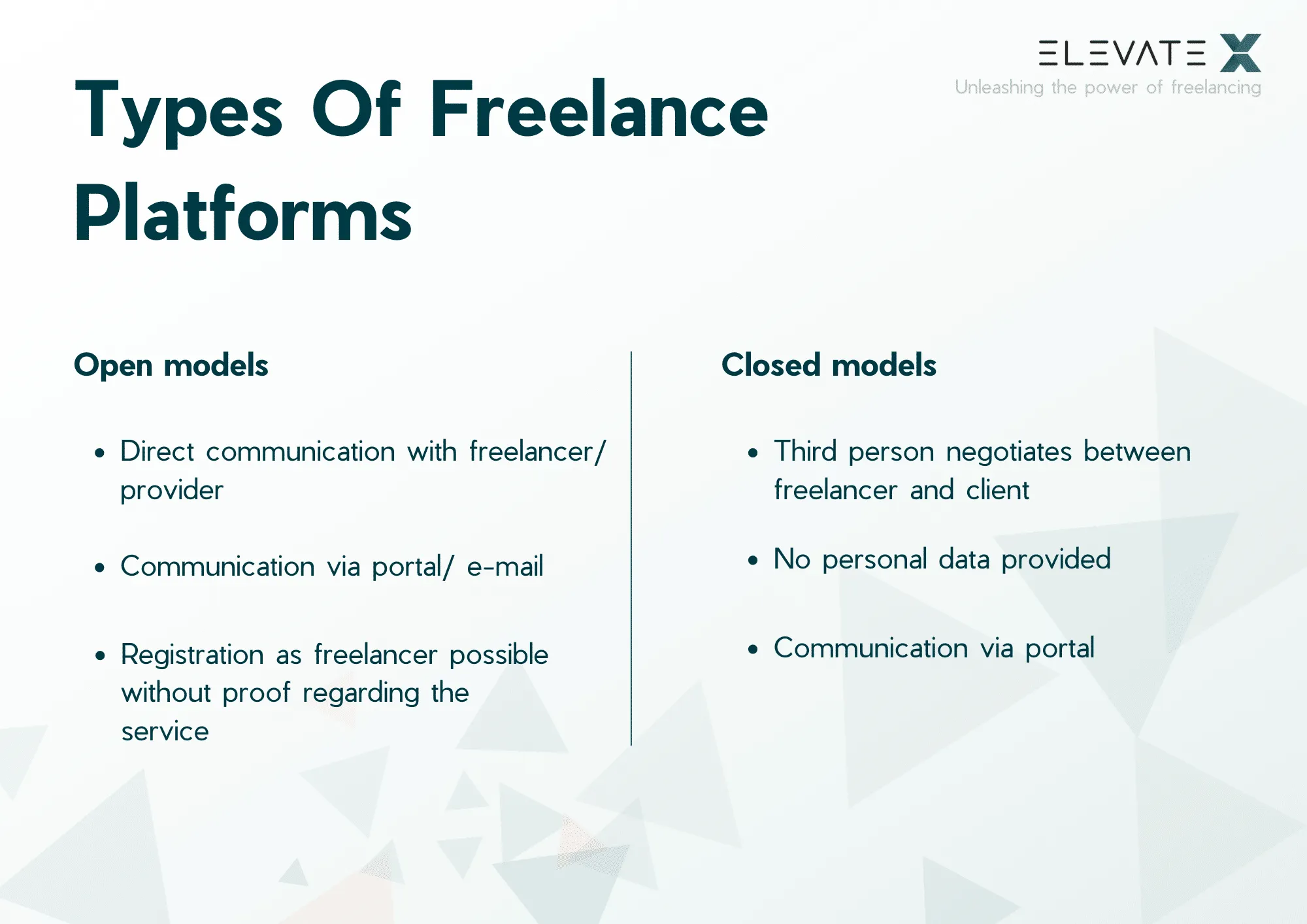
Freelance platforms fall into open and closed models. The difference lies in who can sign up, who vets the freelancers and who you sign the contract with.
Open Platforms
On open platforms, any freelancer can create a profile. A resume, portfolio or proof of skills is not required, and backgrounds are checked little or not at all. Star ratings and comments from previous clients are the main guide. You communicate directly with the freelancer, usually through the portal’s messaging function, and normally sign the contract directly with them.
- Advantages: The selection is huge, prices are often lower, and ratings help you compare.
- Disadvantages: The search takes a lot of time. Since nobody vets freelancers in advance, the risk of hiring someone who doesn’t fit is higher.
Closed Platforms
On closed platforms, the bar is much higher. Freelancers usually have to submit at least a resume, often work samples as well. Some providers add an interview or a test. A third party sits between you and the freelancer. You often sign the contract with the provider rather than with the freelancer. Communication and invoicing run through the portal, and personal contact details are often not exchanged. On the German writing platform content.de, for example, the terms prohibit clients from handling orders directly with writers outside the platform.
- Advantages: Freelancers are vetted and have to prove their experience. Some providers also handle the shortlisting, so you only decide on the profiles presented to you. That is no guarantee of good work, but it lowers the risk of a bad hire.
- Disadvantages: Not everyone is accepted, so the selection is smaller. Vetting and matching cost money, usually as a commission or markup that you pay as the client.
Platform Or Agency?
On a platform, you usually do the searching yourself, even if the talent pool is vetted. You post the job, review profiles, run interviews and decide. With an agency, a provider takes over the search. You describe what you need, receive a shortlist and only talk to the candidates presented to you. The contract and invoicing then usually run through the agency. You save time on the search, but you pay for that work through the price.
Specialized Platforms
Beyond these models, job portals differ in what they offer. More and more platforms specialize to bring clients and job seekers together faster and more easily. This also applies to offers for freelancers. Online, for example, you will find portals with offers for:
-
Doctors
-
Mourners and wedding guests
-
Marketing specialists
-
Copywriters
There are also dedicated platforms and agencies for IT specialists. The IT freelancer agency ElevateX, for example, brings them together with suitable clients.
Freelance Platforms At A Glance
The following platforms differ mainly in who searches, who vets and what kind of work they are built for.
ElevateX

ElevateX is a specialized recruiting boutique for senior IT freelancers from the DACH region. The focus is on pre-qualified, high-seniority talent and short onboarding, so you spend less time on coordination and more on delivery. After a briefing on your architecture, roadmap and team setup, you typically receive up to three hand-picked profiles. You then confirm personal fit in an interview and move straight to the engagement. The network spans software engineering, cloud and infrastructure, product roles and specializations such as SAP S/4HANA. It is aimed at teams that need reliable experts without the long cycles of traditional recruiting.
DasAuge

DasAuge brings creative people together with potential clients. Videographers for music projects, translators, WordPress developers, lecturers, copywriters, designers and many other professionals from creative industries are sought and found on this German-language platform. The job board lists freelance projects, permanent positions and internships. In turn, creatives post their own availability there, which you can browse directly.
Fiverr

On Fiverr, freelancers sell ready-made service packages called gigs, with a fixed scope and a fixed price. You can, for example, have logos and images made for your T-shirt business, book a coach, order translations or get help with video editing. The model works best for small, clearly defined tasks.
Fiverr is an open marketplace: any freelancer can offer gigs there, and star ratings and comments help you compare. You pay when you place the order, and the freelancer only receives the money once the order is complete. For businesses, there is also Fiverr Pro with freelancers that Fiverr says it vets in advance.
99designs

99designs specializes in design, from logos and business cards to T-shirt designs, book covers and packaging. You can launch a design contest and choose from several drafts, or work directly with one designer on a 1-to-1 project. According to 99designs, a curation team regularly reviews all designers from the moment they sign up. Today the platform operates under the name 99designs by Vista.
Upwork

On Upwork, you describe your project in a job post and set the budget and time frame. Freelancers then send you proposals, and Upwork also suggests matching profiles. You can search on your own and invite freelancers directly, too. Ratings and profiles help you choose, but the vetting and the decision are up to you.
Toptal
Toptal is a closed network of developers, designers, project and product managers, management consultants and other experts. According to Toptal, applicants go through a multi-stage screening process with an interview in English, skills tests, live interviews and a test project. Instead of searching yourself, you describe what you need and get matching profiles presented to you. Toptal works in English and operates internationally. If you need freelancers on site or communication in German, clarify that up front.
LinkedIn is not a classic freelance platform but a business network. Still, you will find many freelancers there. You can search profiles, ask your network for recommendations or post a project as a job ad. Through the Services Marketplace, you describe what you need and receive proposals from service providers. You do the searching and vetting yourself and settle the contract and payment outside LinkedIn.
We Work Remotely
We Work Remotely is an English-language job board exclusively for remote jobs. Besides permanent positions, it has a dedicated section for contract and part-time work. As a company, you pay for each listing. You review and vet the applications yourself.
Which Freelance Platform Is The Best?
There is no single best freelance platform. The right one depends on your project: How big and how clearly defined is the task? How long do you need support? And how much time do you want to spend on searching and vetting yourself?
- A small task with a clear result, such as a logo, a translation or a video edit: an open marketplace like Fiverr or Upwork is often enough. For design work, 99designs is an option.
- A creative job in the German-speaking market: a niche job board such as DasAuge reaches exactly this audience.
- A longer IT project or a senior role in your team: experience and team fit matter most here. Closed networks such as Toptal or specialized agencies handle the shortlisting.
- Consulting or interim management: networks and agencies that vet their consultants up front help here, too. On LinkedIn, you can also ask for recommendations.
- A remote position where you pick yourself: a job board such as We Work Remotely brings you applications, and the selection stays with you.
These questions help you compare:
- How are freelancers vetted before you see their profiles?
- Do you choose yourself, or does the provider suggest candidates?
- Who do you sign the contract with, and who sends the invoice?
- What fees apply, for you and for the freelancer?
- Do language, time zone and region fit your team?
- What happens if the freelancer doesn’t fit or drops out?
If you want to bring external developers into your team for a longer period, take a look at staff augmentation. And whichever way you find freelancers, clarify how the collaboration is set up contractually. Our guide to false self-employment explains what to watch out for.
What Does A Freelancer Cost?
According to freelancermap’s Freelancer Compass 2026, a survey of freelancers in the German-speaking market, freelancers charge an average of 103 euros per hour. For IT freelancers, the study reports a median of 95 euros, while SAP and ERP specialists reach a median of 120 euros. The rate in each case depends on the field, experience and project.
At first glance, this may seem expensive. But freelancers carry costs that an employer pays in full or in part for employees: vacation, sick days and contributions to health and pension insurance. The rate also has to cover time for accounting, organization and acquisition.
For your company, what counts is the comparison of total costs. Since freelancers work on specific projects for a limited time, you only pay for the agreed work and no idle time. Whether that ends up cheaper than a permanent hire depends on duration and workload. Our guide to freelancer costs goes into more detail.
Conclusion
Freelancers will continue to be needed in the future, and the demand for their services will increase. Every change in the digital world calls for specialized knowledge. Three-year vocational training programs cannot provide this knowledge fast enough, which is why specialists are increasingly in demand.
Which freelance platform is right depends on your project. For small, clearly defined tasks, open marketplaces are enough. For longer projects and senior roles, vetted networks or agencies that handle the shortlisting are usually the better fit. For freelancers, platforms offer access to projects and the freedom to shape their own working day.
FAQs
Where Can I Find Freelancers?
Which Freelance Platform Is The Best?
What Is The Difference Between Open And Closed Freelance Platforms?
Where Can I Hire Freelance Consultants And Senior Experts?
What Does A Freelancer Cost?



![The 6 Phases Of The Candidate Journey [with Graphic]](/_astro/what-is-the-candidate-journey-featured-en.BElIk8IQ_2j5bqs.webp)