
Many companies run into staffing bottlenecks, for example because of order peaks or new projects. In IT, skilled workers are especially scarce. If you need extra capacity at short notice, there are two main options:
- Use of Freelancers
- Employee Leasing
In this article, you will learn about the pros and cons of both and what the German Act on Temporary Agency Work (AÜG) regulates. At the end, we compare them with contracts for work, outsourcing, and permanent employment and show which staffing model fits when.
What are Freelancers?
Freelancers work independently. Often, they work for multiple clients simultaneously. How do freelancers differ from free employees (Freiberufler)? Our article on the difference between freelancer and free employee has the answer.
Support Through Freelancers
Companies hire freelancers for a specific project. They pay either a flat fee agreed in advance or by the hour.
When Do Freelancers Pay Off for a Company?
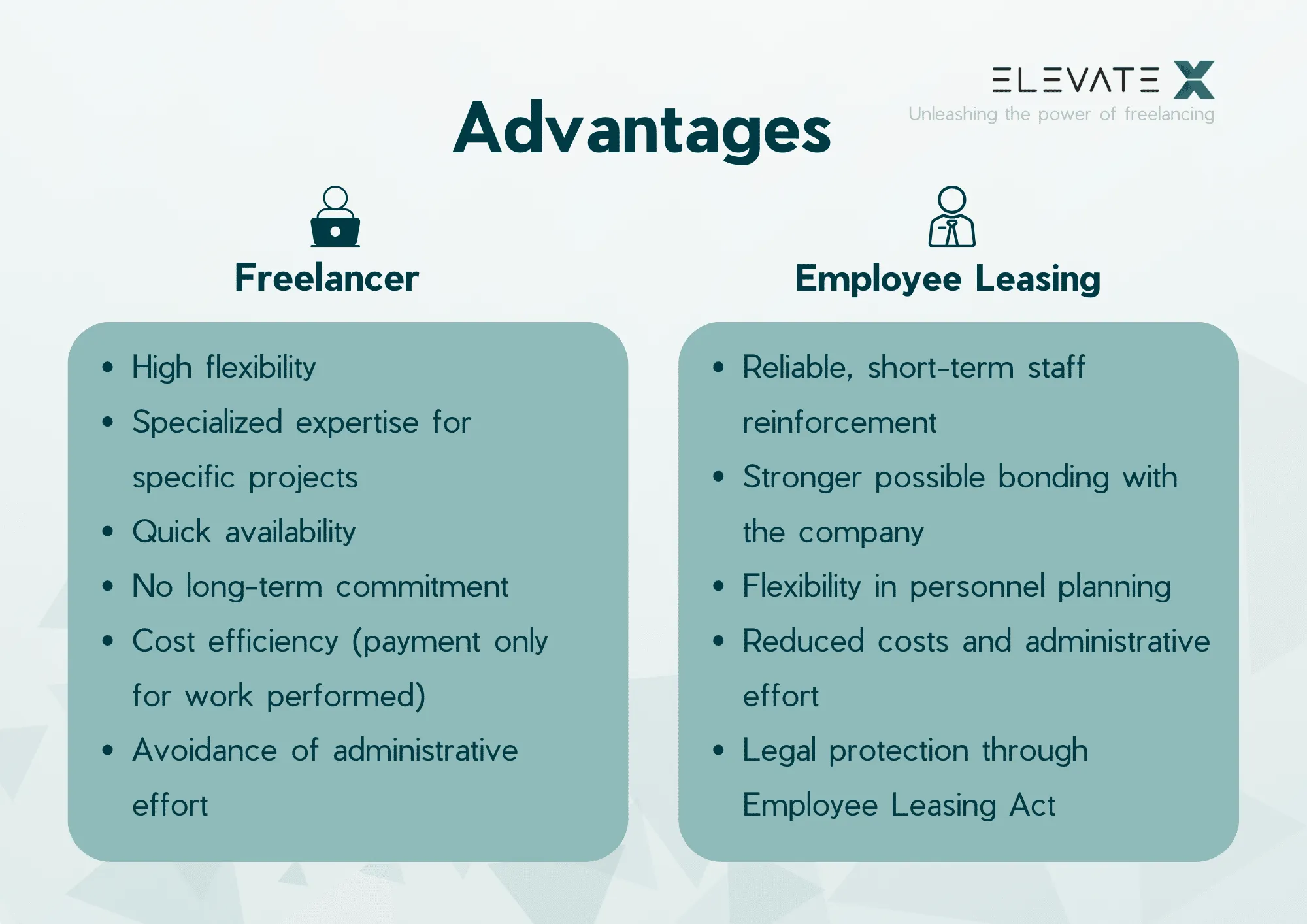
Freelancers suit short-term order peaks or staffing bottlenecks. You deploy them in the projects that are currently important or urgent. Experienced freelancers know similar projects and bring specialist skills your team lacks. Our IT services page shows which IT tasks this can cover.
No Lengthy Search and Hiring Processes
Hiring IT freelancers is straightforward. Lengthy search and hiring processes are avoided. IT freelancers can often move a project forward within a short time, solve a problem, or reach a first milestone. Our blog explains what the time-to-hire metric means and how freelancer onboarding works in six easy steps.
No Costs in Case of Illness
If a freelancer falls ill, you pay no fee for those days. You only pay for the hours worked, and vacation days remain unpaid too. No employer social security contributions are due: the freelancer pays their own social contributions and taxes from their fee. Our article on insurance for the self-employed covers which insurance freelancers need.
Freelance Platforms for IT Professionals
Many IT professionals value flexibility and find their projects through freelance platforms. Our comparison of freelance platforms shows which ones work well for IT projects.
Watch Out for False Self-Employment
When you work with freelancers, watch out for the criteria of false self-employment. German law names two indicators of employment: working under instructions and being integrated into the instructing party’s work organization (Section 7 (1) SGB IV). These are exactly the features that define employee leasing.
If it later turns out that a supposed freelancer was in fact an employee, for example during an audit by the German Pension Insurance (Deutsche Rentenversicherung), you as the client must pay the social security contributions retroactively. These claims only become time-barred four years after the end of the year in which they fell due, or after 30 years if contributions were withheld intentionally (Section 25 SGB IV). Late-payment surcharges can come on top. Our guide to false self-employment explains how to avoid it.
What is Employee Leasing?
Employee leasing is also known as personnel leasing, temporary agency work, or temporary work. In Germany, the legal basis is the Act on Temporary Agency Work (Arbeitnehmerüberlassungsgesetz, AÜG). Companies mainly use it to absorb short-term fluctuations in orders.
Definition of Employee Leasing
An employer (the lender) temporarily provides its own employees to another company (the borrower) as part of its business. The key point: the leased employees are integrated into the borrower’s work organization and follow its instructions (Section 1 (1) AÜG). The lender generally needs a permit from the German Federal Employment Agency (Bundesagentur für Arbeit) to do this.
How Does Employee Leasing Work?
You send your requirements to the staffing agency. The agency looks for a suitable specialist who is employed by it or is hired for the assignment. You then sign the leasing contract, and the specialist works at your company for the agreed period.
Contractual Relationships in Employee Leasing
An employee leasing contract is concluded between the personnel agency (the lender) and the commissioning company (the borrower). The agency is the worker’s employer and holds their employment contract. There is no employment contract between the worker and the company where they are deployed.
Remuneration and Fees
You pay the personnel agency an agreed rate, usually per hour. From this, the agency pays the worker’s wages and social security contributions, and the rest covers its costs and profit. As the employer, the agency approves vacation requests, ideally in consultation with your company.
When Does Employee Leasing Pay Off?
Employee leasing pays off when you need specialized skilled workers at short notice for ongoing or planned projects and want to manage them like your own staff within the team.
Advantages of Employee Leasing for Companies
You only pay for the hours actually worked, and the agency handles payroll and social security contributions. This is not entirely risk-free, though: if the agency fails to pay the social security contributions, you as the borrower are liable for them like a guarantor (Section 28e (2) SGB IV). So choose a reputable staffing provider with a valid permit.
Advantages of Employee Leasing at a Glance
- Flexibility
- Planning with a short lead time possible
- Low risks in personnel procurement
- Low administrative effort
- Transparency regarding the required working hours
The AÜG as Legal Basis
You can find the current German text of the AÜG on gesetze-im-internet.de and guidance for companies (in German) from the Federal Employment Agency. The information in this article reflects German law as of October 2026 and is not legal advice. If in doubt, have your contracts reviewed by a lawyer specializing in employment law.
Contents of the Employee Leasing Contract
Since 1 January 2025, the contract between lender and borrower only needs to be in text form (Section 12 (1) AÜG), for example by email. A handwritten signature is no longer required. It should contain in particular (Section 1 (1) and Section 12 (1) AÜG):
- an explicit statement that the arrangement is employee leasing (labeling requirement)
- the name of the leased employee before the assignment starts, in the contract or with reference to it (specification requirement)
- the lender’s declaration of whether it holds a permit for employee leasing
- the specific features of the job and the professional qualifications it requires
- the essential working conditions, including pay, that apply to comparable permanent staff, unless a collective agreement exception applies
Breaches of the labeling and specification requirements can be costly: fines of up to 30,000 euros are possible (Section 16 AÜG), and in some cases an employment relationship between the leased employee and the borrower is deemed to exist (Sections 9 and 10 AÜG).
Maximum Duration of Employee Leasing
Employee leasing is only permitted on a temporary basis: as a rule, the same leased employee may be assigned to the same borrower for no more than 18 consecutive months (Section 1 (1b) AÜG). The limit applies per person, not per position. What counts is the agreed assignment period, not the number of days worked. Earlier assignments with the same borrower count towards the limit, even if they ran through a different agency. Only a break of more than three months between two assignments resets the clock. Collective agreements in the borrower’s industry can set a different maximum. If the maximum is exceeded, an employment relationship between you and the leased employee is deemed to exist, unless the employee declares in time that they want to stay with the agency (Sections 9 and 10 AÜG).
Equal Pay Principle
From day one, leased employees are in principle entitled to the essential working conditions of comparable permanent staff at the borrower, including pay (principle of equal treatment, Section 8 AÜG). A collective agreement for temporary agency work may deviate from this, but for pay generally only during the first nine months of an assignment with the same borrower. A longer deviation is only possible under an industry surcharge agreement that raises pay step by step and reaches a level defined as equivalent after 15 months at the latest. Such agreements only exist for certain industries, such as the metal and electrical industry or the chemical industry. The German staffing industry association Gesamtverband der Personaldienstleister (GVP) lists them (in German). Without such an agreement, equal pay is due from the tenth month at the latest.
Freelancers and Employee Leasing in Comparison
- Direction: You can direct leased employees like your own staff and fully integrate them into your team. Freelancers organize their own work and are not bound by your instructions.
- Duration: You hire freelancers for a project or a task. Leased employees work for you for an agreed period, usually no more than 18 months per person.
- Costs: With both, you only pay for the work performed. In employee leasing, the agency’s rate covers not only the wage but also the agency’s costs and margin. Which option is cheaper depends on the individual case.
- Legal risk: Employee leasing removes the risk of false self-employment because the worker is employed by the agency. In return, the permit, the contract, the maximum duration, and equal pay must all be in order. Freelancers, on the other hand, must not be integrated like employees.
Which Staffing Model Fits When?
Freelancers and employee leasing are not the only ways to get external IT support. Contracts for work, outsourcing, and permanent employment are further options. The models differ mainly in who directs the work and what you are buying: a worker, an activity, or a result.
| Model | Who directs the work? | A good fit if … |
|---|---|---|
| Freelancers (usually a service contract) | the freelancer | you quickly need specialist skills for a project that you lack in-house |
| Employee leasing (contract under the AÜG) | you, as with your own staff | someone should work in your team and follow your instructions, usually for no more than 18 months per person |
| Contract for work, e.g. with an agency | the contractor, and you accept the result | you want to buy a clearly defined result, such as an app or an interface |
| Outsourcing (external IT department) | the IT service provider, with services defined in service level agreements | you want to hand over an entire area for the long term, such as IT operations or support |
| Permanent employment | you, as the employer | the task is a permanent part of your core business and the know-how should stay in-house |
Contract for Work, Service Contract or Employee Leasing?
These three types of contract sound similar but cover different things:
- Contract for work (Werkvertrag): The contractor owes a result, such as finished software (Section 631 BGB). They organize the work themselves, direct their own staff, are liable for defects, and are usually paid for the result.
- Service contract (Dienstvertrag): The contractor owes an activity but no specific result (Section 611 BGB). Many IT freelancers work this way. They bill by the hour or day but largely decide for themselves how and when the work gets done.
- Employee leasing: You buy neither a result nor an activity. Instead, you get a worker who is integrated into your operations and follows your instructions (Section 1 (1) AÜG).
The title of the contract is not what counts: if the contract and its actual performance contradict each other, the actual performance decides (Section 12 (1) AÜG). If you direct a service provider’s employees day to day like your own staff, this may be covert employee leasing. Fines can follow, and in some cases an employment relationship between those employees and your company is deemed to exist (Sections 9 and 10 AÜG). The Federal Employment Agency explains the criteria it uses to tell these arrangements apart in a fact sheet (in German).
External IT Department or External IT Expert?
When people look for an external IT department, they usually mean IT outsourcing: a service provider takes over tasks such as IT operations, maintenance, or support for the long term. Service level agreements (SLAs) define what the provider delivers and how quickly it responds. This takes work off your team but makes you dependent on one provider. So make sure the agreements are complete and check how sensitive data is handled. You can read more in our article on outsourcing, nearshoring, and offshoring and on our IT outsourcing page.
An external IT expert, on the other hand, is a single specialist who joins your project for a set period, either as a freelancer or as a leased employee. You keep responsibility for the project and bring in exactly the know-how you are missing. This model is also known as staff augmentation.
Conclusion
Employee leasing or freelancers? Both spare you a lengthy recruiting process and bring in support quickly.
Which model fits depends above all on how closely the person should be integrated into your team and how long you need them. For projects with a deadline and specialist skills you need for a limited time, freelancers are usually the right fit. If external specialists are to work in your team under your instructions, employee leasing is the legally sound route. For long-term core tasks, permanent employment remains the first choice.
FAQs
What are Freelancers?
What is Employee Leasing?
When Should You Use Employee Leasing and When Freelancers?
Which Staffing Model Fits When?
What Is an External IT Department?



![The 6 Phases Of The Candidate Journey [with Graphic]](/_astro/what-is-the-candidate-journey-featured-en.BElIk8IQ_2j5bqs.webp)