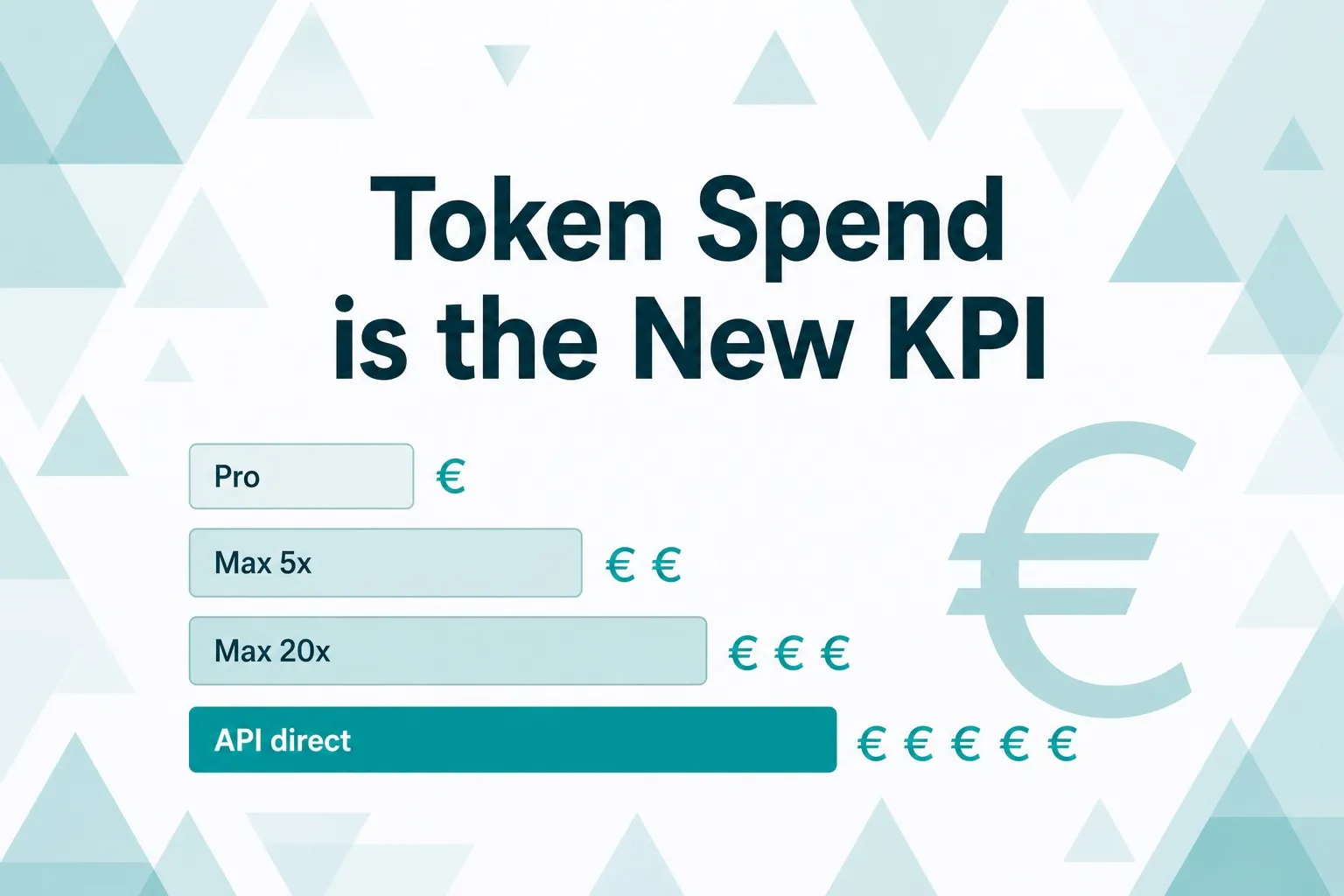
Token spend per engineer is a leadership metric in 2026. A CTO in Germany who hires a senior for 110,000 euros (closer to 150,000 euros fully loaded) and grants them 20 euros of tokens per month isn’t using the available tool. Tunguz calls tokens the fourth compensation component. Jensen Huang sets 50 percent of engineer salary as the minimum target for token spend in the US market. Meta ran an internal dashboard tracking 85,000 employees live, called Claudeonomics in-house, until it shut the experiment down in April 2026.
For DACH hiring in practice that means: subscription tier is a diagnostic question worth asking, not a verdict on its own. Someone still on Pro at 20 euros is worth a closer look at how they actually work. A senior who deploys Max 20x or direct API with judgment beats three junior hires.
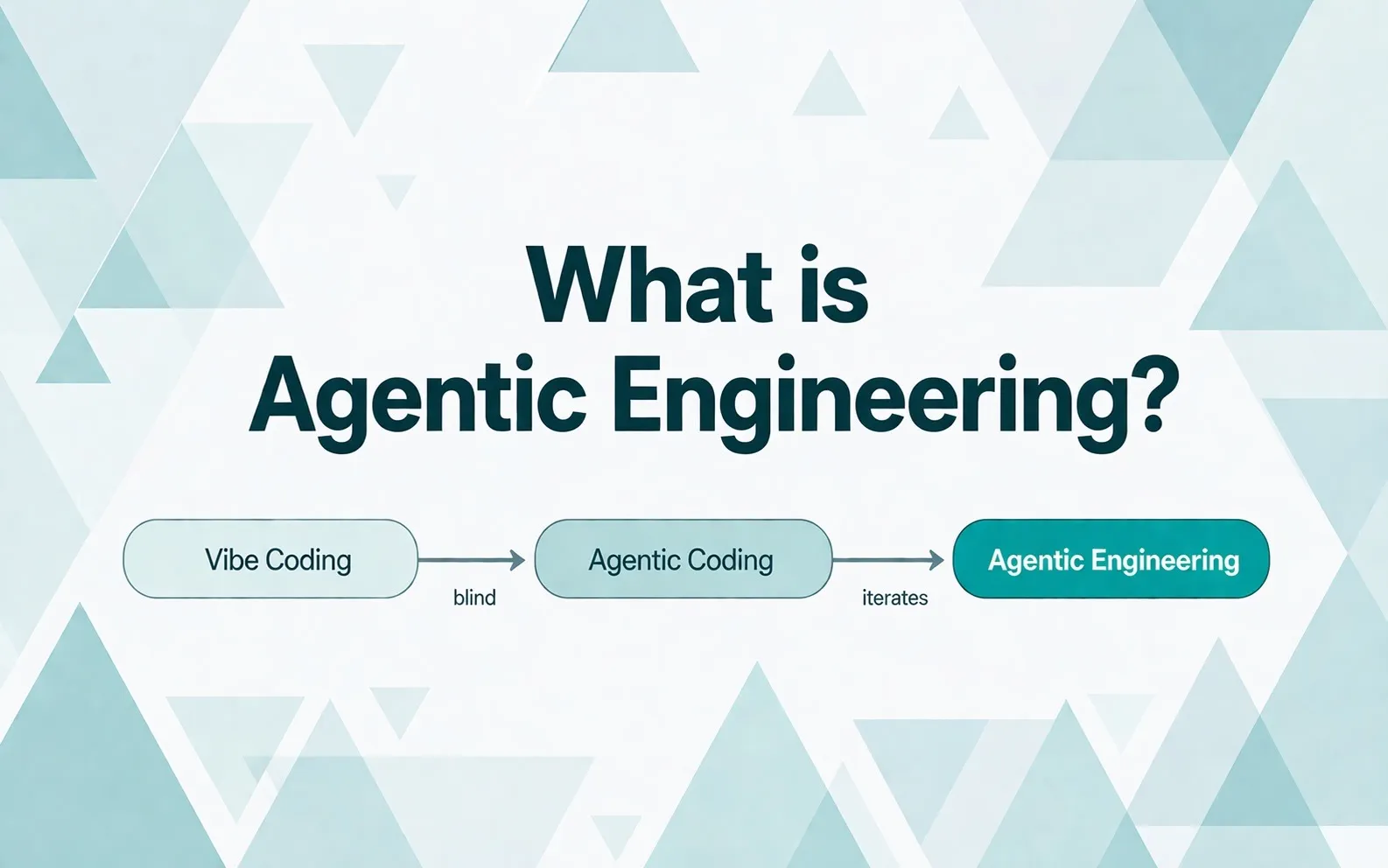
This article is the diagnostic deep-dive in our cluster on Agentic Engineering and Hiring 2026. It brings the numbers, the tier math, and what it concretely means for hiring. The term and definition are in What is Agentic Engineering.
In March 2026, Jensen Huang, CEO and co-founder of NVIDIA, said something on the All-In Podcast that has been quoted in every other engineering pitch since:
“If that $500,000 engineer isn’t consuming at least $250,000 in tokens, I’m going to be deeply concerned.”
50 percent of engineer salary. As a floor, not a ceiling.
Huang’s analogy for engineers who don’t do this was unusually sharp for a CEO who otherwise speaks diplomatically. It would be like a chip designer working with pencil and paper and refusing to use CAD tools. Technically possible. Commercially absurd.
A familiar analogy makes it tangible: you’ve been tracking ad spend per performance marketer for twenty years. The more budget someone can deploy effectively, the more valuable they are. Nobody would give a senior marketer 100 euros in ad budget and then wonder why the results are flat. In 2026 the same logic applies to engineering teams. The only difference: it’s now called token spend.
That number is the provocation. But it isn’t the most important number in this article.
Tunguz: the fourth compensation component
Tomasz Tunguz, general partner at Theory Ventures, was the first to name the concept cleanly in early 2026. In his essay “Will I Be Paid in Tokens?” he lays out the math:
“Technology companies are adding a fourth component to engineering compensation: salary, bonus, options, & inference costs.”
Tunguz’s calculation comes from the US market: a software engineer at the 75th percentile takes home $375,000 in salary. Plus $100,000 in inference costs, that’s $475,000 in fully loaded personnel cost. Over 20 percent is already tokens, not compensation in the traditional sense. Translated to a DACH senior at 110,000 euros base plus 1,500 to 3,000 euros of tokens per month: similar ratio, different absolute numbers.
Tunguz’s expectation of an engineer who burns $100,000 a year on inference is explicit: “They’d better be 8x more productive!” That’s the ratio Tunguz uses as a benchmark. It forces a question every CTO should be asking: what is the productive work per dollar of inference? That’s the new unit economics of engineering talent.
Tunguz lives by his own sermon. In April 2026 he documented on X: “Two days ago, I burnt 250 million tokens in a single day. That’s up 20x in six weeks.” He calls it tokenmaxxing: the deliberate practice of maximizing token consumption because parallelization is the lever. The question he poses to his LPs is not “how do we save compute?”. It’s “how much electricity can we turn into useful work?”
Meta built a token leaderboard, then shut it down
In early 2026 a story made the rounds in VC circles that tipped the concept from theoretical to operational, and then became its first cautionary tale. A Meta engineer built an internal dashboard tracking AI token consumption across more than 85,000 employees, internally called “Claudeonomics.”
Around April 8, 2026, Meta shut it down, officially because the dashboard data was being shared externally. By then the deeper problem was already visible. Token consumption is an input metric, not an output metric, closer to lines of code than to delivered value. Engineers admitted to gaming it, leaving agents running for hours on throwaway tasks to climb the ranking, with some production incidents traced back to code generated more for volume than for quality.
That backlash doesn’t weaken the case for token spend as a leadership metric. It sharpens it. The number on its own tells you how much compute someone deployed, never whether they deployed it well. Which is exactly why the lever in the rest of this article is token spend paired with senior judgment, and never token spend alone.
Charles Lamanna, Microsoft’s Corporate Vice President for Business Apps and Platforms, reported around the same time that candidates in engineering interviews now actively negotiate on this. Candidates explicitly say they would take the job “as long as their team gets a certain dollar amount of AI tokens.” Compute now sits alongside salary and equity in the negotiation.
That’s the movement Tunguz and Huang described individually. Now in the form that’s reaching HR departments, with the quality caveat already attached.
What tokens actually cost in 2026
The order of magnitude is moving fast: Anthropic quietly doubled its own estimate of token costs per engineer in April 2026. Three numbers still give CTOs the frame: cost per task, cost per engineer per month, and the lever between subscription and direct API billing.
Per task: $0.20 to $4
A single agentic task typically consumes 50,000 to 200,000 input tokens and 5,000 to 20,000 output tokens. At Anthropic pricing ($3 per million input on Sonnet 4.6, $5 on Opus 4.7; output $15 and $25 respectively), that’s $0.20 to $4.00 per task. Multiply by three to five parallel agents in a multi-step workflow and a senior practitioner quickly lands in the two- to three-figure dollar range per day.
Per engineer per month: 150 to 250 euros in daily workflow
In enterprise deployments, Anthropic reports an average of $13 per active day, which is 150 to 250 euros per engineer per month. 90 percent of users stay under $30 per active day. Heavy users on direct API billing reach 500 to 1,500 euros per month. Boris Cherny, inventor and lead engineer of Claude Code at Anthropic, merges 150 pull requests on peak days with 5 to 10 parallel sessions plus cron-triggered overnight loops, putting him in the five-figure dollar range per month. That’s the upper peak, not a DACH standard, but it shows the scale.
Subscription vs. direct API: factor 18
The subscription model is the decisive lever. Over 90 percent of the tokens Claude Code processes are cache reads at 10 percent of the input price. Concretely: a heavy user on Max 20x ($200 per month) would pay $3,650 per month for the same token volume on direct API billing. One documented case from 2026: 10 billion tokens over 8 months for $800 on Max subscription instead of $15,000 in API cost. 93 percent savings.
| Tier | Cost/month | Suited for | Diagnostic signal |
|---|---|---|---|
| Claude Pro | $20 | Hobby, side projects, single tasks per week | Beginner or occasional user, a signal worth probing in a discovery call |
| Claude Max 5x | $100 | Daily driver, 1–2 parallel agents | Advanced practitioner |
| Claude Max 20x | $200 | Heavy user with 3–5 parallel agents | Senior practitioner, standard for agentic engineering 2026 |
| Direct API billing | $200–$1,500+ | Maximum flexibility, team setups with their own tooling layer | Very advanced, or team-lead setup |
Cursor established the same tier logic in April 2026: Pro $20, Pro+ $60, Ultra $200. The market structure has converged.
Gartner: the money is shifting from people to compute
What Tunguz, Huang, and Meta show individually, Gartner backed up empirically at the macro level in April 2026. The current IT spending forecast brings three numbers that should be on every CFO’s desk in 2026:
- Worldwide IT spending: +13.5 percent in 2026, to $6.31 trillion
- Data center spending: +55.8 percent. That’s the actual driver
- Headcount growth in engineering organizations: down from 6 percent to 2 percent
Only 21 percent of CFOs are still planning staff increases of 4 to 9 percent for 2026. Last year it was 31 percent. Gartner calls it a “structural pivot from labor expansion to optimization through automation and AI, delivering productivity gains without proportional headcount growth.”
In plain English: the money isn’t flowing into more engineers anymore. It’s flowing into compute that multiplies the engineers who are already there.
The supply side confirms the picture from the other direction. Greg Brockman, President of OpenAI, on the question “Do you have enough compute?” (May 2026): “No. Definitely not. When we launched ChatGPT, my team asked: ‘How much compute should we buy?’ I said: all of it.” “Demand for intelligence is unbounded,” Brockman says verbatim. If the largest compute provider in the world can’t keep up, token scarcity isn’t a temporary market phenomenon. It’s structural. That doesn’t change the math in the per-engineer token budget. But it explains why Tunguz’s and Huang’s recommendations aren’t going to cool off.
Compute without judgment is just a bigger bill
Before this starts to sound like token maximalism, the most important caveat. Tokens pay for execution. They don’t pay for decision.
A weak operator with a $250,000 token budget produces $250,000 of plausible-looking but unusable code. A strong operator with a $50,000 token budget produces $50,000 of code that solves the right problem. Which one is more valuable?
In April 2026, Sequoia laid out exactly this shift in an essay by Julien Bek, a Sequoia Capital investor focused on AI infrastructure: intelligence (writing code, translating specs, debugging) has become commodity. Judgment (deciding what to build, what architectural debt to take on, when to ship) stays human and gets more expensive. The core sentence that belongs in every CTO pitch:
“Every AI improvement makes the tool cheaper and judgment more valuable.”
For more on that shift, we worked through Karpathy’s terminology pivot in our definitional deep-dive. The point for this article: a token budget without senior judgment in the team is an expensive form of code generation. Not a lever.
Four independent voices are saying the same thing in early May 2026. Karpathy, co-founder of OpenAI: “You can outsource thinking. You can’t outsource understanding.” Brockman: “Human attention is the new bottleneck.” Liu: “The agents are powerful enough. The question is whether you invest the time to coach them.” Cherny: “For me, coding is solved. Not everywhere.” Four positions (researcher, operator, CEO, builder), all giving the same diagnosis. Token spend is the tool. Senior judgment is the lever. Both need each other.
And a caveat to the caveat: token budgets are not equity. TechCrunch put it cleanly in March 2026 — token budgets “don’t vest, they don’t appreciate, and they don’t show up in your next negotiation the way base salary or an equity package does.” They’re discretionary spending. Something that gets negotiated, measured, controlled. That’s part of the lever. But it doesn’t make them a real compensation substitute.
How CTOs should track token spend operationally
If token spend is a KPI, it has to be measured. Four concrete steps that we keep formulating as standard recommendations in discovery calls in 2026:
1. Monthly per engineer. Not aggregated across the team. Every senior gets a visible token-spend number per month, like a cloud account. Anyone who consumed under 50 euros at month-end isn’t using the tools. Meta built its own dashboard for this, then retired it. You don’t need your own — the Anthropic and OpenAI admin consoles supply the data.
2. Per task category. Not every task is equally token-intensive. Codebase-level refactoring consumes a multiple of a simple code-generation request. The distribution shows where the workflow is agentic and where it’s just AI-supported.
3. In the hiring brief. “What subscription tier do you run on Claude Code or Codex?” belongs in every discovery call with senior candidates as a standard diagnostic question. Where to find the right senior profiles, and which four behavioral anchors replace the CV phrases, lives in Find a Senior Agentic Engineer 2026.
4. In performance reviews. Not as a mandatory consumption target, but as a diagnostic indicator. A senior engineer whose token consumption has stagnated or declined over 12 months is most likely frozen in a 2024-vintage workflow. Cortex and Jellyfish now list token spend as a standard KPI in their engineering dashboards. Healthy ROI on AI coding tools sits at 2.5x to 3.5x on average, 4x to 6x in the top quartile. But only when the cost side includes real token costs.
What this means for hiring
Three concrete shifts that should land in every CTO’s hiring brief in 2026:
Subscription tier as a standard discovery-call question. The answer reveals more than three pages of CV, as a signal to probe rather than a pass or fail. Pro = worth asking how they actually work. Max 5x or 20x = senior practitioner. Direct API = very advanced or team-lead setup.
Token costs are rounding errors in the senior budget. A senior freelancer at 120 euros per hour costs around 19,000 euros per month (at 160 hours utilization). The 200 euros for Max 20x is roughly one percent of that. Anyone saving on tooling and going for a cheaper senior on a Pro subscription is optimizing the wrong line.
Performance evaluation with compute efficiency. Not “how much did we burn”, but “how much value per dollar burned”. Tunguz’s 8x ratio as a reference point: anyone burning $100,000 in inference should be 8x more productive without it, otherwise the lever isn’t working.
The practical application of these points lives in the interview guide with 21 questions. Phase 1 question 2 tests token maturity in 10 seconds.
If you’re thinking about token budget right now
The most common observation in CTO calls in 2026: the company has cleared the licenses. Nobody’s using them seriously. Tokens are being burned at a baseline that sits in single-digit euros per engineer.
That’s not a tooling problem. That’s a hiring and workflow problem. Senior engineers who operate agentically bring the tool consumption automatically to where Tunguz, Huang, and Meta describe it. If you don’t have the consumption, you don’t have the hire.
We place senior freelancers whose setup runs in the right order of magnitude from day one. Not consultants, not workshop providers. Engineers who deliver in the middle of the team and build out the internal AI champion on the side.
Drop Sören Elser, our founder and managing director, a quick message on LinkedIn, wherever you’re at right now. Or send a concrete request to our team. We get back to you personally.
FAQs
How much should an engineer spend on tokens per month?
How does Claude Code compare to direct API billing on cost?

![Agentic Engineering Hiring Interview 2026 [+21-Question PDF]](/_astro/agentic-engineering-interview-featured-de.BlvVAp5j_Z9ib7o.webp)