

More and more companies work with freelancers. Especially when it comes to the shortage of IT specialists, freelancers are a good way to fill gaps in your team.
Still, many companies hesitate. In our survey on LinkedIn, we asked which problems companies see most often when working with freelancers. Answers included false self-employment, costs, and the worry that freelancers only help in the short term.
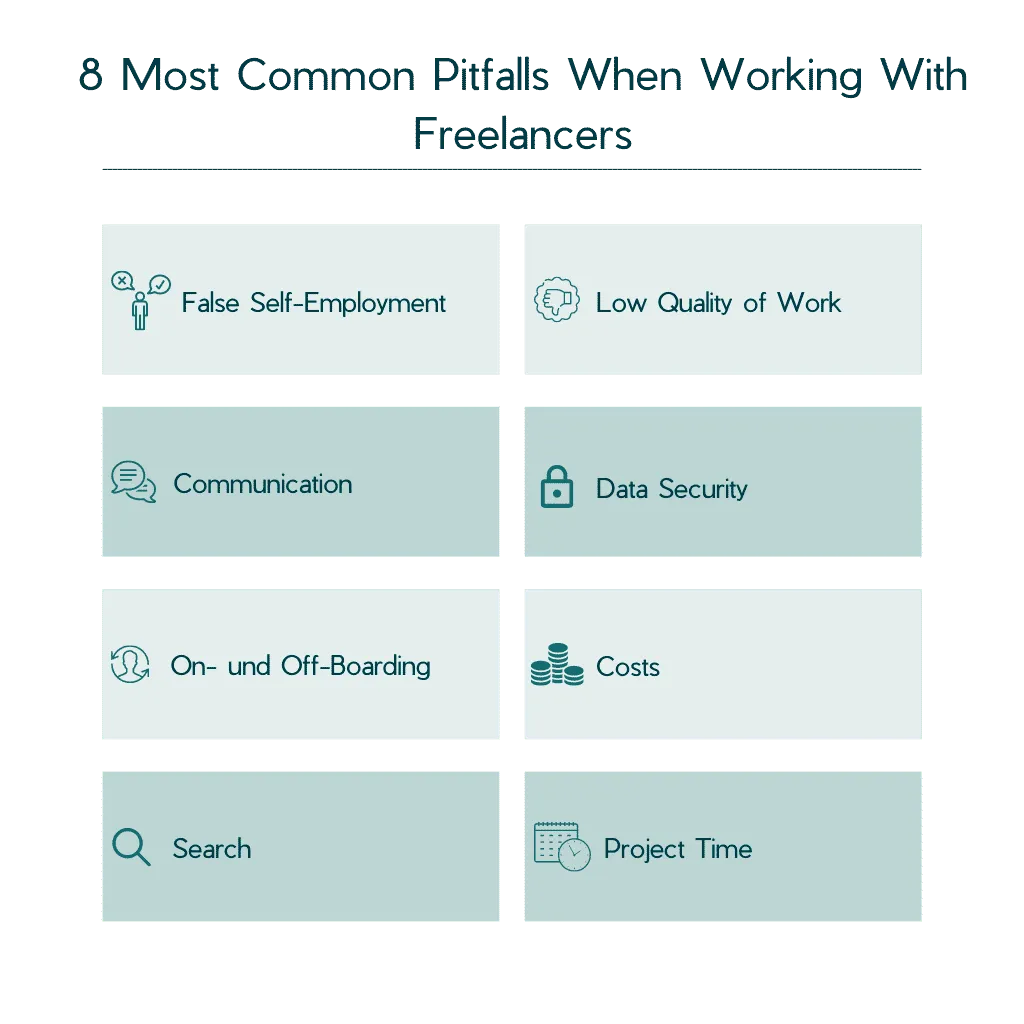
In this article, you’ll learn which eight problems come up most often, why many of them aren’t real problems, and how to fix them, usually with simple steps. We also show you how to lead freelancers from a distance, what to do when an ongoing collaboration stalls anyway, and how to part ways cleanly if you have to.
What Are the Most Common Pitfalls When Working With Freelancers? (And How to Approach Them Best?)
Especially if you have never worked with freelancers before, there are several things to consider (video in German). This applies to the entire process, from finding the right freelancer to the collaboration itself and the end of the project. But even experienced companies run into problems they didn’t see coming.
Our experience with clients shows that hurdles don’t only appear during the collaboration. Important points are often overlooked during the search already.
Once you know the typical problems (video in German), you can avoid most of them or act early. Below you’ll find the eight most common ones, each with a solution. After that, we look at leading from a distance and at what to do if a project stalls anyway.
Problem: “There is a risk of false self-employment when working with freelancers.”
The issue of false self-employment keeps many companies from working with freelancers. They consider the legal risk too great.
A few ground rules help you keep that risk low.
Solution:
-
Make sure freelancers work toward results, not fixed working hours.
-
Freelancers are not bound by instructions. As a rule, they decide for themselves when, where, and with what equipment they work, for example remotely and on their own hardware.
-
Don’t integrate freelancers into your organization like employees. German social security law (Section 7(1) SGB IV) names two indicators of employment: working under instructions and being integrated into the instructing party’s work organization.
You’ll find more points and a detailed checklist in our guide to false self-employment.
Problem: “Communication is too complex.”
Language barriers, cultural differences, or different time zones can become a challenge. On top of that, freelancers work independently and flexibly, while companies have fixed structures and processes. When these two worlds meet without clear agreements, communication quickly gets complicated over the course of the project, and misunderstandings follow.
Solution:
-
Look for freelancers in your area, or freelancers from your own language and cultural background who live abroad.
-
Check the freelancer’s language skills beforehand and state your expectations clearly in a personal meeting.
-
Before you start, agree on your communication channels: for example, a board for tasks and deadlines such as Trello, Asana, or Monday.com, and a chat like Slack or Microsoft Teams.
-
Agree on when you’ll sync on project status, for example in a short weekly update. That way, small problems surface before they grow.
-
At ElevateX, we specialize in helping you find freelancers who fit your project’s requirements.
Problem: “Freelancers take too long to get started on a project.”
The idea that freelancers need a long time to get up to speed is usually wrong. Many are used to joining projects at short notice and quickly adapt to new routines and ways of working.
Solution:
-
A detailed briefing is key: project goal, requirements, desired results, and deadlines. The more precisely you describe tasks and content, the sooner productive work can begin.
-
Make sure your team is familiar with working with freelancers too. Explain why you need the freelancer and why the collaboration matters.
-
As a company, leave a good impression, for example by paying invoices on time. This creates a positive atmosphere and makes future projects easier.
Our guide to freelancer onboarding shows how to structure the first days.
Problem: “It is too time-consuming to find a matching partner.”
The search for project partners already involves several things to consider. It is often difficult to find suitable freelancers in a short time who are also available.
Solution:
-
A network that offers you a wide selection of freelancers often helps.
-
Use connections to project partners you have worked with before. They can often refer you to other partners in the industry.
-
At ElevateX, we can also help you find suitable partners for your projects quickly and easily. We review your requirements and introduce you to possible project partners from our network of verified experts within a short time.
Problem: “Freelancers often deliver lower quality work than permanent employees.”
In general, that’s not true. Freelancers are not bound to fixed work structures and often deliver even better work as a result.
On the other hand, a freelancer may have several projects at the same time and deliver sloppy work because of it. Often, though, the problem isn’t the freelancer’s skills but unclear requirements. Without a specific briefing, even a good freelancer is left in the dark and misses what you actually need.
Solution:
-
Pay attention to the freelancer’s hourly rate during the search. If it is unusually low, it may be a sign that the freelancer is juggling several projects at once.
-
Set clear expectations before the collaboration begins. Agree on deadlines and deliverables that both sides stick to.
-
Give feedback regularly, not just at the end of the project, for example after each milestone. Focus on the agreed result: What already works, and what is still missing?
-
Provide a positive working environment. In a pleasant atmosphere, everyone enjoys their work more and gets more done.
Problem: “Freelancers are not safe when it comes to data protection.”
Because freelancers usually work remotely, the risk of sensitive data leaking is higher than with permanent employees in the office.
Nevertheless, the risk can be reduced to a minimum.
Solution:
-
Make sure your partner uses a VPN to encrypt the internet connection.
-
Everything else is usually a given for professional freelancers. This includes not using public or unencrypted networks. A sufficiently large mobile data plan helps, so the freelancer’s own smartphone can serve as a hotspot.
-
When working in public spaces, no one should be able to see sensitive data. That means secure passwords, screen locks, and possibly privacy screen protectors for mobile devices.
Problem: “Freelancers are too expensive.”
That freelancers are too expensive is probably one of the most common statements we hear. It helps to look at what freelancers actually cost and how the price is made up.
According to freelancermap’s Freelancer-Kompass 2026, the median hourly rate for IT freelancers in German-speaking countries is 95 euros. Depending on the field, the median ranges from 90 euros in software and web development to 120 euros for SAP and ERP.
That may look high at first. But the hourly rate covers a lot that you pay on top for permanent employees:
- Freelancers don’t get paid vacation.
- They aren’t insured through your company.
- They bring their own hardware.
- You don’t pay for their training.
Whether a freelancer pays off for you depends mainly on project length and workload. You can compare both options with your own numbers using our freelancer vs. employee cost calculator.
Solution:
-
Still, plan with realistic costs. If you expect high quality, expect higher rates too.
-
Be clear about which skills you need and what you expect from the collaboration. The more precisely you can assess this, the better you can estimate hourly rates.
In this post, we’ve summarized how freelancer costs break down in detail and what you can roughly expect as a company.
Problem: “Freelancers are not a long-term solution.”
A typical misconception is that freelancers can only be hired for a few months. However, freelancers can also work with you long term and be contracted for periods of around two to four years.
Compared to permanent employees, this is not an unusual period. According to Stepstone (2023), employees in Germany change jobs every four years on average. So freelancers can be a medium- to long-term option compared to permanent staff.
In addition, a freelancer’s hourly rate usually goes down for longer projects, because a longer project means more financial security for them.
Solution:
-
Look specifically for freelancers who are available for longer periods. If they juggle many projects and have mostly had short projects in the past, they are less suitable.
-
Make sure that false self-employment does not occur, especially with longer project durations.
Leading Freelancers From a Distance
Leading from a distance, also called distance leadership or remote leadership, means leading people who don’t work in the same place as you. With freelancers, it doesn’t mean giving instructions the way you would with employees. You agree on goals, provide access and information, and stay reachable. Build on the channels and check-ins from the communication section:
-
Results, not presence: Agree on goals and delivery dates. Measure progress by what’s delivered: closed tickets, a demo, a milestone reached. When and how the freelancer works is generally up to them. Fixed online hours like an employee’s don’t fit freelance work, not least because of the false self-employment risk.
-
Write it down, talk when it matters: Record status, open questions, and decisions in the ticket or project wiki. Then nobody waits for the next meeting. Discuss criticism and sensitive topics by video or phone. Chat lacks tone of voice and facial expressions, so short messages easily sound harsher than intended. After the first few weeks, check together whether the rhythm and channels work.
-
Availability: Remote freelancers often get stuck waiting for an approval, a login, or a decision from your team. So name a fixed contact person who answers questions quickly. In return, agree that the freelancer tells you early if a delivery date is at risk.
-
Trust over control: Constantly asking for updates or watching someone’s online status costs trust and tells you little about progress. Instead, ask the freelancer at the start what they need from your team, and later, what’s slowing them down. And say so when something went well, even with a quick “Well done” in the chat.
-
Tools for knowledge and access: Besides the board and chat, you need one shared place for documentation, such as a wiki in Confluence or Notion. Give the freelancer access to everything they need for the project from day one, and nothing more.
-
Same information in mixed teams: When employees sit in the office and freelancers work remotely, two levels of information build up fast. Anything discussed in the office that affects the project belongs in the shared channel, in writing.
Freelancer Collaboration Gone Wrong? Here’s What to Do
Even if you follow the eight points above, a project can stall. Typical warning signs are slipping milestones, questions that go unanswered, or results that don’t match your expectations. Usually, unclear goals, too little exchange, or priorities nobody agreed on are behind it. If the freelancer also works for other clients, your project can quickly slide down their list without firm deadlines. And anyone expecting a finished result overnight often underestimates how little insight an outsider has into your internal processes.
Address Problems Right Away
Don’t wait until the end of the project. Sit down with the freelancer, ideally on a call or in person, and name the problem specifically: What was agreed, what has been delivered, and where is the gap? Ask for their view. Often a misunderstanding or missing information is behind it, and one conversation can clear it up.
Realign Goals and Timeline
If the original goals are no longer achievable, adjust them together with the freelancer. That’s better than ending up with a result nobody is happy with. The same goes for deadlines: if something unexpected happens, discuss whether and how you can adjust the timeline without putting quality at risk. Put the new agreements in writing: What will be delivered by when, and how will you know it fits?
Escalate if Nothing Changes
If the conversation doesn’t help, set a fixed date to review progress together. Bring in other people if needed, such as the project lead. If the freelancer came through an agency, involve them early. Keep the focus on the agreed result. Rules about working hours or methods don’t fit freelance work and can increase the risk of false self-employment.
Part Ways Cleanly and Plan the Handover
Sometimes it just doesn’t fit. Then a clear end is better than a project that drags on for months. Check the contract first: term, notice periods, usage rights, and agreed handovers. Our guide to freelancer contracts explains what belongs in one. Then plan the handover:
- Collect documentation, code, and work in progress in one place
- Record open tasks and their status
- Pass knowledge on to your team or the successor, ideally in a joint session
- Revoke all access: accounts, VPN, repositories, and tools
- Settle invoices for the work delivered
Finally, take a moment to look back: Was it the briefing, the selection, or too little coordination? The answer helps you fill the next role more precisely.
How Can ElevateX Help?
By working closely and personally with our business clients, we know their needs and how to address them together. With our experienced team of experts, you won’t even face most of the problems mentioned, and we make sure the entire project runs smoothly.
As a company, you tell us your expectations and requirements, and we help you find a suitable freelancer for your project as quickly as possible. We are also happy to help if you have questions or doubts. Numerous experiences of our clients show that hybrid teams of freelancers and permanent employees can bring considerable value to a company. Good and clear communication is crucial. This usually allows doubts and sources of problems to be discovered and eliminated very quickly.
If you would like to learn more about working with freelancers or are looking for the right experts for your project, you can book a free consultation call here, and we will help you find suitable project partners quickly and easily.
FAQs
What are the most common problems when working with freelancers?
How do you build a successful collaboration with freelancers?
How should I give feedback to a freelancer?
What can I do if a collaboration with a freelancer stalls?
How do I end a collaboration with a freelancer cleanly?