

To keep up in a fast-moving world, you need to know the latest working tools and technologies. New working strategies and technologies shape the work of freelancers more and more. Thanks to their flexibility and their ability to adapt quickly to new circumstances, freelancers have an edge that sets them apart from the rest of the market.
In this article, you’ll learn which trends are shaping IT freelancing, how companies use and find freelancers today, and how you can prepare with continuous learning and a well-kept profile.
Working strategies of freelancers
New Work supports personal and professional development by introducing different ways of working. With digitalization moving fast, freelancers need up-to-date skills.
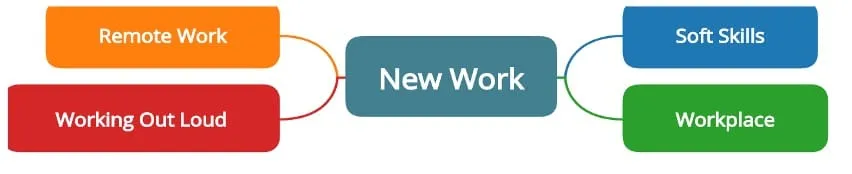
The following points highlight what makes New Work such an important strategy.
- Soft skills are increasingly in demand, such as time management, communication skills, or self-motivation.
- Concerning the workplace, freelancers can work from different places. Therefore, many resort to coworking spaces, where independent workers can meet and motivate each other instead of working alone at home.
- One of the methods that New Work contains is called ‘Working out Loud’. This method aims to build working relationships based on mutual support that work towards a shared goal. It especially helps freelancers to bring their ideas into a company and to share them with others. The feedback at the end is the key to this method to extend the gained knowledge. Exchange is essential to freelancers, as they often work alone. ‘Working out loud’ therefore supports the agile approach of companies that use freelancers as guides for project teams.
- Remote work has become the norm for many experts. According to Germany’s Federal Statistical Office (Destatis), 25% of all employed people in Germany worked from home at least occasionally in 2025, up from 13% in 2019. In IT services, the share was almost three quarters (74%) in 2025.
Remote collaboration: what changes for you
For many freelancers, working from anywhere has long been normal. By now, many companies have adapted to it as well. That gives both sides more flexibility, because location and time play a smaller role in working together.
At the same time, the way you communicate changes. Face-to-face meetings become rarer, and coordination happens over video calls and tools such as Microsoft Teams or Zoom. For you, this means that clear agreements, fixed communication channels and well-documented results matter more. They replace the quick chat in the hallway.
Additional success factors for freelancers
Not only New Work but also sales, the legal situation, and sustainability are important factors for the success of any freelancer. The upcoming points serve as an overview of the different topics.
- For most freelancers, winning the right clients is the key to success. Especially at the beginning of a career, it is important to build a client base to receive regular inquiries. As the freelancer market keeps growing, several online platforms match companies with freelancers. This is where ElevateX can support. As experienced experts, we find the perfect match for freelancers and companies by providing reliable support.
- Enhancing future working strategies also means dealing with sustainability. Paperless offices and digital correspondence are no longer new concepts. Also, the already mentioned coworking spaces enable resource sharing. Another opportunity: you can work as a freelancer directly in the sustainability sector, where demand for specialists is growing.
- A recurring issue is false self-employment, also called pseudo-self-employment. The risk mainly concerns companies that hire freelancers, but it also affects you as a contractor. What matters is that the contract and the actual collaboration match and that both sides clarify the topic early. Learn more in our guide to false self-employment.
How companies use and find freelancers
Freelancers instead of internal staff: what companies hire you for
With freelancers, companies are no longer limited to what their own employees know. For each project, they bring in exactly the specialists whose skills are needed right now. Often, they also want to add capacity flexibly or close a gap because a full-time position can’t be filled in time.
For you, this means that deep knowledge in your field makes you relevant for many projects, and broad knowledge around it for even more. Since technology cycles keep getting shorter, you need to update that knowledge continuously. What is in demand today will need an update tomorrow.
Platforms, networks and your profile
The term gig economy describes the awarding of temporary contracts to self-employed people, for example freelancers. Platforms and agencies often bring both sides together, and many companies search there for specialists for their projects. On top of that, companies use networks like LinkedIn to find suitable freelancers.
Three things help you get found:
- Register with platforms and agencies: Once your profile is in their database, you are more likely to be found as a project partner and suggested for suitable projects. Our comparison of freelance platforms gives you an overview.
- Make yourself visible: Your own website, a portfolio with reference projects and well-maintained contacts help clients find you and remember you.
- Keep your LinkedIn profile in shape: One well-kept profile beats several half-finished ones. Use your headline to say briefly what you do and for whom, with the terms clients search for. In your About section, include your area of expertise, your skills, your years of experience and what you are best known for. List your project experience so companies can judge whether you are a good fit. And post regular updates about your work so your profile stays current.
You’ll find more ways to win new projects in our tips for better client acquisition.
Self-development
Perhaps the most important success factor for any freelancer is self-development. People turn to freelancing because they see the benefits of being flexible, deciding about the projects they work on, and they can mostly choose their workplace. Self-development also means taking the risk of leaving employment and starting out as self-employed. Further education is therefore essential to keep up with the newest technologies.
How to keep learning in a targeted way
Make learning a fixed part of your schedule. That applies to hard skills such as new frameworks or cloud platforms and to soft skills such as time management or public speaking. You can approach a new technology field, for example artificial intelligence, in three steps:
- Get started: Books, articles and videos give you a first feel for the topic. For complex relationships, they are usually not enough.
- Go deeper: Online courses, for example on Coursera, and webinars take you deeper into a topic in a structured way. For machine learning, it also pays to look at the math, because ML systems are built on formulating and solving mathematical problems cleverly.
- Stay up to date: Follow what leading companies and research teams in your field publish. That way, you see what a technology can already do and what it can’t do yet.
Our overview of the most important AI resources collects good starting points for AI. The three steps work just as well for any other technology field.
What areas are best for further development?
Latest technology trends: where IT is heading
With the rise of new technologies, the demand for IT freelancers also rises. Companies want to stay dynamic and adopt the newest technologies. This is why they increasingly turn to freelancers, who always keep up with the latest developments.
Fields with high demand include IT security, artificial intelligence, cloud services, the Internet of Things and big data.
-
IT security is gaining importance. It is a highly sensitive area in which companies particularly value the expertise of freelancers.
-
Artificial intelligence aims to create intelligent machines that help people develop technologies further and push digitalization forward. Freelancers in the field of machine learning are therefore in high demand. AI is also changing how software gets built: in agentic engineering, developers steer AI agents that write, test and fix code.
-
Cloud services are infrastructure, platforms and software that a third-party provider runs and delivers over the internet. Digitalization in companies has made them essential, which leads to more efficient and productive working structures. Again, this is a very rewarding field for freelancers, as it keeps changing and the latest skills are always required.
-
No list of current technologies is complete without the Internet of Things. Smart devices are connected to the internet and are everywhere to simplify daily life. Not only in the household, but also at work. These tools are in constant development and improvement and therefore need highly flexible and adaptable experts.
-
As AI and the Internet of Things grow constantly, they also transmit huge amounts of data. A technical term for this is big data. Thanks to augmented analytics, we are able to work with complex amounts of data. AI, the Internet of Things, and big data are strongly connected to each other.
-
Last but not least, you need the right programming languages. Python in particular has gained ground: in the Stack Overflow Developer Survey 2025, 57.9% of all respondents used Python, 7 percentage points more than in 2024. Stack Overflow sees this as a sign that Python is the go-to language for AI, data science and back-end development. Our ranking of the most important programming languages shows which other languages are in demand.
Conclusion
As you have seen, the best foundation for freelancers is a mix of current working strategies and know-how in key fields. To make sure companies find you, you also need a well-kept profile and an active network. At the same time, continuous learning must not be neglected, because those who rest on their success miss out on future topics.
If you are a freelancer and interested in helping to develop future technologies, then ElevateX helps you to find the perfect project for YOU! Click here for more information.
FAQs
Which trends are shaping IT freelancing?
Why do companies hire freelancers instead of internal staff?
How do freelancers find projects today?
What does remote work mean for you as a freelancer?
How can you prepare for new technologies as a freelancer?