

For many freelancers, client acquisition is the hardest part of being self-employed. When you are just starting out as a freelancer, you often lack references and a network that sends inquiries your way. And even with a full calendar, acquisition still matters, because the next project rarely starts exactly when the current one ends.
How do you win new clients as an IT freelancer? Which channels are worth your time, and what should you keep in mind?
In this article, you will find 7 tips for better freelance client acquisition, the difference between cold and warm outreach, and a compact guide to winning projects through LinkedIn.
What Does Client Acquisition Mean for Freelancers?
Client acquisition means reaching out to new clients and winning projects. Freelancers have many ways to do this: phone calls, emails, LinkedIn, their own website, platforms, referrals, or ads. Which ones fit depends mainly on your target group and your budget.
As an IT freelancer, you usually deal with two kinds of clients: companies that hire you directly, and agencies or IT service providers looking for freelancers for their clients’ projects. At a company, you talk to IT managers or project leads. At an agency, you talk to recruiters.
Cold and Warm Outreach: The Difference
What Is Cold Outreach?
Cold outreach is the first contact with people who do not know you yet. It can be a conversation at a conference, a phone call, or a connection request on LinkedIn. Cold outreach matters because you should keep growing your client base, especially when you are new to freelancing.
However, cold outreach is often tedious. You will get a lot of rejections, and some people see it as unwanted advertising. There are legal limits, too. In Germany, you may generally only send promotional emails with the recipient’s prior express consent, and that includes businesses. Promotional calls to businesses require at least presumed consent (Section 7(2) UWG, the German Act against Unfair Competition). Other countries, including other EU member states, have their own rules. If in doubt, get legal advice.
Are you thinking about starting freelancing? Then you can download our detailed eBook with all the important information for a successful start.
What Is Warm Outreach?
Warm outreach is usually much more efficient than cold outreach. You approach people you have already introduced yourself to or worked with. Referrals and existing relationships count, too. The key is to keep these contacts alive, even when you are not looking for a project.
Digital Warm Outreach: Keeping Contacts Warm Online
With digital warm outreach, you use online channels to stay on the radar of people who already know you:
- Check in after a project ends: A few weeks after wrapping up, ask how the project is going. Sometimes that leads to a follow-up assignment.
- Announce your availability: Tell former clients and colleagues in good time when you will be free again and what you would like to work on.
- Stay present on LinkedIn: Comment on former clients’ posts and congratulate them on new roles. People who see your name more often are more likely to think of you when a project comes up.
- Ask for referrals: Ask happy clients directly whether they know anyone who could use your skills.
7 Client Acquisition Strategies for Freelancers
Besides cold and warm outreach, the channel you use to reach clients matters. These 7 tips help you find the right channels.
If your acquisition is successful, you can prepare for a technical job interview in the next step.
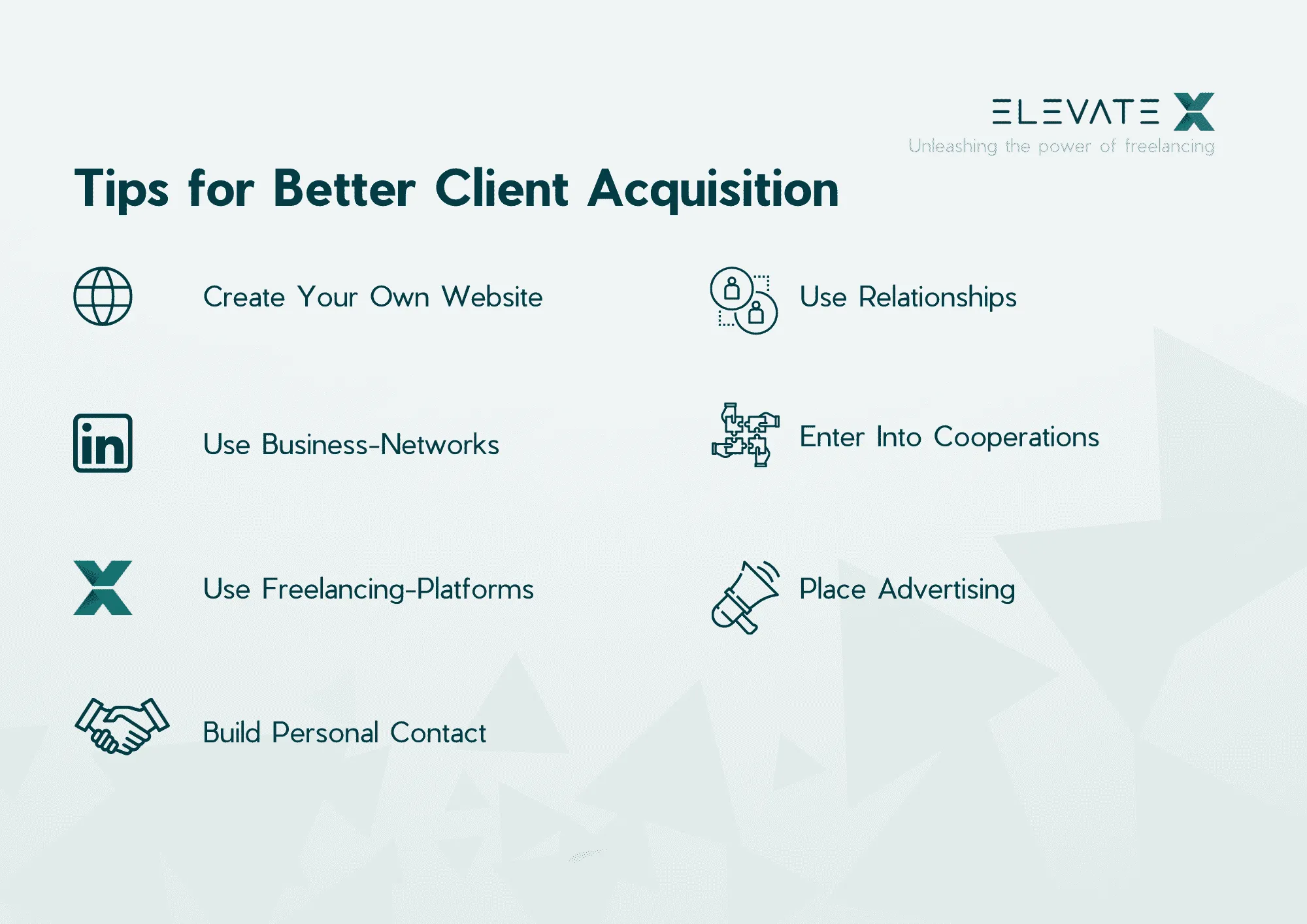
Create a Website and a Portfolio
A website of your own lets companies learn about you. Make it clear what you offer: your tech stack, reference projects, and how to reach you. As an IT freelancer, you can also link to your GitHub profile or your own open-source projects. If you are not allowed to name clients, describe the industry, the task, and the result.
To help clients find you on Google, SEO (search engine optimization) matters: your website should contain the terms people search for in your field. A blog about topics from your field supports this and shows what you know.
Use Business Networks Like LinkedIn
For networking online, LinkedIn is the obvious place. You can search for projects and build contacts in a targeted way. Xing, the German-language network, repositioned itself as a job platform in 2023, and networking and content are no longer its focus (onlinemarketing.de, 2023).
Just like with a website, a meaningful profile matters here. You will learn how to set it up and win projects through LinkedIn further down.
Use Freelancing Platforms
Freelancing platforms are an effective way for both freelancers and companies to find suitable project partners. Platforms and agencies also take part of the acquisition work off your plate, because companies actively look for freelancers there. At ElevateX, we bring IT freelancers and companies together to put exciting tech projects into action. You can register here.
Build Personal Contacts
Meeting people in person often leaves a stronger impression than online contact. For IT freelancers, tech conferences, meetups, and user groups work well, as do trade fairs and training courses. Make sure people can reach you afterwards, for example with a business card or by connecting on LinkedIn right away. Even if the person you are talking to has no project right now, the contact can pay off later.
Use Your Relationships
Projects do not only come from former clients. Private contacts at companies or fellow freelancers can also help you land new assignments. So build a network of different contacts and keep it warm.
Partner With Other Freelancers
You can also team up with other freelancers. The advantage: you and your partners can recommend each other to clients when a project needs skills you do not have yourself. Often you can also win assignments as a team, for example when a client wants frontend, backend, and DevOps from a single source.
Run Ads
Depending on your target group, budget, and expectations, there are different ways to advertise. They range from classic ads in local newspapers to promotional texts and videos on platforms such as LinkedIn or YouTube. Start with a small budget and check whether it actually brings in inquiries before you spend more.
LinkedIn Tips for Freelancers: How to Win Projects
LinkedIn is where many of the people who award IT projects spend their time: IT managers, project leads, and recruiters at IT service providers. LinkedIn reports more than 1.3 billion members worldwide (LinkedIn, as of 2026). The basic features are free, and you do not need a Premium subscription to get started. To be successful on LinkedIn, four things matter.
Profile: How Clients and Recruiters Find You
Clients and recruiters search LinkedIn by role and technology. Your profile should contain exactly those terms.
- Profile photo: a recent, well-lit photo that shows only you.
- Headline: The text below your name also appears in search results. Include your role, your focus, and the word freelance, for example “Freelance Android Developer | Kotlin, Jetpack Compose”.
- About: Describe in a few short paragraphs what you offer, for whom, and with what result. Mention that you work as a freelancer.
- Experience: Add your freelance business as its own position and list individual projects below it, each with the task and the result.
- Skills and recommendations: Add the technologies you want to be hired for and link them to the matching positions. Ask former clients and colleagues to endorse your skills and to write you a short recommendation.
- Contact info: Make your email address or website visible. If you are not on LinkedIn every day, turn on email notifications for new messages.
Show Your Services and Availability
Via “Add profile section” and “Add services”, you can create a Service Page and list what you offer. You can also allow prospective clients to message you even if you are not connected. According to LinkedIn Help, without Premium Business, Sales Navigator, or Recruiter Lite your profile only shows a preview of your services description, and there is no “Request services” button. Also mention in your posts or your About section when you will be available for new projects.
Build Your Network With Purpose
Start by connecting with people who know your work: former colleagues, clients, and project partners. Then connect with decision-makers and recruiters in your target industry. After connecting, send a short, personal message with a real point of reference instead of a sales pitch. Sheer numbers do not help much. People who cannot place you will not get in touch when a project comes up.
Stay Visible and Find Projects
Regular posts put you in the feeds of your contacts and their networks. Write about what you learn in projects: a problem you solved, a tool that proved useful, a short case study without confidential details. Posts that do well can be highlighted in the “Featured” section of your profile.
You can also find projects on LinkedIn directly. Set the search filter to “Posts” and look for phrases like “looking for a freelancer” together with your technology. Freelance projects also show up in the job search, often posted by agencies.
What Do I Need to Keep in Mind During Client Acquisition as a Freelancer?
Besides choosing your channels, there are a few things you should sort out in advance.
Analyze Your Target Clients
Determine beforehand what your ideal client looks like and select potential contacts based on these criteria. For every company, ask yourself whether it could really be interested in your services.
Set SMART Acquisition Goals
Set concrete goals instead of approaching every company you can find. The SMART principle helps: a goal is specific, measurable, achievable, relevant, and time-bound. One example: contact ten former project contacts and set up three calls by the end of the quarter. Block fixed time for this every week, even when you are fully booked.
Approach Marketing the Right Way
Make sure you present your value properly. As a freelancer, you are not a salesperson but a problem solver. Explain to the people you talk to how you contribute to the success of their project.
Good acquisition starts before you contact anyone. With inbound marketing, clients notice you on their own, for example through your LinkedIn posts, your website, or a blog. People who are convinced by your content and references get in touch by themselves.
Define Your USP
Successful marketing also includes defining a USP, short for unique selling point. It describes what sets you apart from other freelancers, for example an industry you know well or a rare combination of technologies. Your USP is the reason companies should hire you rather than someone else.
Handle Rejection Professionally
Especially in cold outreach, you will get plenty of rejections. Accept a clear no and stay friendly. Pushing further usually comes across as intrusive. If you react calmly, you leave a good impression, and maybe the next project will be a fit.
The reverse is also true: learn to say no yourself. Turn down projects you do not have time for or that do not pay in line with your hourly rate. Decline in good time and give a short reason. Sometimes the project can be moved to a later date. A clear no also shows clients that they can rely on you.
Conclusion
Do not rely on a single channel for client acquisition. A mix is often the most effective: a well-kept network, a meaningful LinkedIn profile, a website with references, and platforms that take part of the acquisition work off your plate. Find out which channels work for you and improve them step by step.
Good work remains the foundation, because happy clients recommend you to others. Comedian Steve Martin put it this way: “Be so good they can’t ignore you.”
FAQs
What does client acquisition mean for freelancers?
What is the difference between cold and warm outreach?
What is digital warm outreach?
How do freelancers get projects through LinkedIn?
How can freelancers win new clients?