ElevateX speaks with Komplexitäter co-founder Lars Nebe about agility, flexibility, and moderating online workshops, which have now become essential.
Agility has played a decisive role at ElevateX since day one, both in our customer projects and in the structure of our entire organization. For us, it is one of the basic requirements for living one of our core principles: the ability to work productively, flexibly, and from anywhere.
At the same time, it is essential not to confuse agility with flexibility or treat the two as identical. The following video shows what agility actually means, after which we explain how we live it at ElevateX.
What does agility mean for ElevateX?
For us, agility means that we need very clear and strict, but transparent rules and processes that every team member, employee, and project can rely on. At the same time, these frameworks are continuously reviewed and iteratively adjusted so that we can react to changing external influences at any time or improve our team’s satisfaction and productivity.
That does not mean reacting exaggeratedly to every small issue or bending the rules whenever it is convenient. On the contrary, lived agility creates very clear boundaries for a team. One example is the need for daily check-ins for every team member in a development project. The goal is always to create synergy, remove obstacles early, and increase the team’s efficiency. In this way, we create the best possible working environment.
Agility as the basis for flexibility
This example already shows why agility also means a high degree of flexibility for us: it provides the framework that enables us and our team members to work from anywhere. Of course, a few prerequisites must be in place, such as a stable internet connection or the ability to join the necessary meetings, but everything else is up to the individual.
Prerequisites for agility
Beyond the necessary technical setup, what matters first and foremost are people with the right mindset. Only then can a system of flexible and remotely collaborating teams work. Anyone who always wants clearly defined requirements regarding when and how work should be done will never feel comfortable in such a system and will not be able to perform at their best. But for people who see flexibility as a real benefit, who enjoy spending longer periods in unfamiliar places while still remaining productive, who like taking more responsibility for themselves and the task at hand, and who bring the necessary discipline and self-motivation, this is exactly the right system.
ElevateX and the Komplexitäter
Because agility is so important for our projects and our daily work, we regularly exchange ideas with specialists in this field. That is why we are in close contact with the Komplexitäter - a Berlin-based company made up of three absolute experts and agile coaches who specialize in helping clients introduce and implement agile methods.
Recently, we had the opportunity to speak at length with Lars Nebe, one of the three Komplexitäter founders. For many years, he has supported a wide variety of teams as a Scrum Master in finding their way in a changing and ever more virtual world. We spoke with him between two workshops, and he gives us an insight into his day-to-day work and how it has changed since the coronavirus crisis, which currently no longer allows in-person workshops.
Conversation with Lars Nebe - “We always think about which concrete problem needs to be solved first and only then do we look at whether and how it can be solved with a new digital tool.”
ElevateX: Lars, you are an agile coach. What does that mean and what does your everyday work usually look like?
Lars: That is actually very diverse and therefore not so easy to answer. In general, it is about helping people adapt better and better to changing conditions. In the age of digitalization and globalization, that is becoming more and more central.
I work a lot with teams, but also with leaders or mixed groups of people, and help them get to know agile principles, understand them, and then apply them to a very concrete situation. This can involve methods such as Scrum or Kanban. But it does not have to.
One of my main tools is facilitating shared workshops. That ranges from Scrum meetings such as plannings, reviews, and retros, to multi-day team workshops where teams think about how they want to work together, all the way to specific exercises on feedback behavior or dealing with conflict. Anyone who wants a more concrete picture can find many colorful examples on our inspiration page.
”The whole social interaction I was used to had to be reinvented.”
ElevateX: You have been working exclusively remotely with your teams for several weeks. How has that affected the workshops you moderate?
Lars: The whole social interaction I was used to had to be reinvented. The entire dynamic of a workshop works differently. For example, questions you ask to the room no longer work. Other communication methods, such as how you present yourself in a room, also cannot be used remotely. More than before, everything now revolves around the question: how can I involve people? Right at the beginning, organizations that are not used to remote collaboration often struggle with small details - sometimes you need 15 minutes at the start of a workshop before everyone is set up.
ElevateX: How do your clients typically deal with these new conditions? Were there any particular challenges they had to overcome?
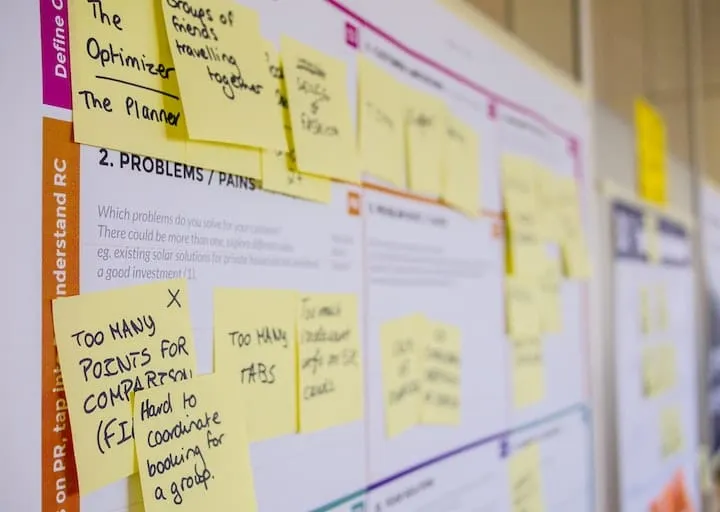
Lars: My clients were actually already very well equipped technically. But that does not solve their core problem: whole communication and information channels disappear. In online meetings and video calls, for example, Post-its and whiteboards no longer exist in the familiar form. So how do I deal with that if I want to prioritize topics, for example?
The organizational focus is often not yet right. Sometimes there are too many technologies, but how they are supposed to be used has not yet been discussed or is only worked on very little. That then leads to problems. For example, people do not immediately find the right communication tool for the respective situation.
ElevateX: Do participants in one of your online workshops need to prepare specially or bring certain skills?
Lars: No. But as a moderator, you need to develop an internal picture of how well people can cope with the situation. Then you can adjust accordingly. For situations in which something might go wrong, I already think through a backup plan in advance.
”Besides the obvious challenges, there are also plenty of advantages!”
ElevateX: What disadvantages do you experience as a moderator in remote collaboration, especially in your online workshops, and what advantages or opportunities does the new format also create?
Lars: You do have to get used to talking to a screen instead of seeing people. It helps a little if everyone really has their camera on, so I can see the mood. I look for tools that support me as a moderator. For example, there are video conferencing providers where I can mute or unmute participants if they forget. When that works, it helps me a lot and I can better adapt to the situation in the workshop. As a moderator, I want to get a sense of where people are mentally at the moment. But tools alone cannot eliminate all disadvantages. A lot also has to do with redesigning the workshop itself and developing new formats.
ElevateX: And the advantages?
Lars: There are, of course, advantages too. Overall, the barriers to entry are lower today than they were just a few weeks or months ago. Before Covid, many clients expected everything to happen in person. And people are now quicker to engage with digitalization and develop enjoyment and flexibility when using the tools. I can support them in that.
For example, I build a check-in area into every tool for participants, where they first enter their name when they arrive in the tool. One team then started drawing funny faces they could recognize themselves in. I had not planned that, but it made them happy and worked really well.
With the new tools, you can create a different kind of interaction, and with the right tweaks it is sometimes even easier to involve everyone.
The number of possible tools is huge - the key is choosing the right ones.
ElevateX: Can you give us a few examples of typical workshop methods you use and the online tools you use to implement them?
Lars: There are, of course, many. For example, moderated group discussions or decisions, for which we often use formats like Fishbowl or group consent. There are also many colorful Scrum retrospective methods such as Starfish Retro, Lean Coffee, or Build your own Scrum Master. There are also specific workshops that create more of a learning effect, such as Kanban Flow Simulation, or that support creative processes, such as Event Storming or User Story Mapping - the range of possibilities is limitless and constantly growing.
For remote workshops, I usually use a combination of different tools. On the one hand, there are the well-known video conferencing systems such as WebEx, Jitsi, and so on, or online whiteboards like Miro or Google Jamboard. But there can also be very specific tools for surveys, for example Mentimeter and Doodle, or Planning Poker.
If necessary, we also build the tools ourselves and make them available. For example, my two co-founders are currently developing a tool for Kanban simulation.
ElevateX: Do you think all workshop formats also work remotely?
Lars: No - each case has to be looked at individually. Some things simply do not work online, or at least work very differently. Then you either have to change the communication accordingly or rethink the workshop altogether. My trick is not to simply recreate the methods known from physical workshops with Post-its, whiteboards, and the like 1:1. I always think again about which problem the approach is actually meant to solve and look at how that can be solved with the new digital tools.
ElevateX: What typical pitfalls can participants in an online workshop avoid?
Lars: In general, you should check in advance what technical requirements the tools need and make sure you actually have the right hardware: good headsets for everyone, up-to-date browser versions, that kind of thing. You can check all that beforehand so the workshop can start right away.
And of course, at the beginning of a workshop, everyone should agree on the basic rules together: cameras on, microphone off when you are not speaking. That already helps so that you can focus again on the actual goal of the workshop.
If you want more tips on this, you will also find many practical methods, possible solutions, and some basic thoughts on the topic of remote workshops here on our website.
Many thanks to the Komplexitäter and Lars for the conversation, your time, and the valuable insights into your daily work!
Do you have questions about how we work or want to talk to us about our approach to agility and new work? Then get in touch via our contact form!
FAQs
What should you know about the interview with Lars Nebe - 'We always think about which concrete problem needs to be solved first - and only then do we look at whether and how a new digital tool can solve it.'?
What should you know about 'The whole social interaction I was used to had to be reinvented.'?
What should you know about 'Besides the obvious challenges, there are also plenty of advantages!'?

![Agentic Engineering Hiring Interview 2026 [+21-Question PDF]](/_astro/agentic-engineering-interview-featured-de.BlvVAp5j_Z9ib7o.webp)