Self-employed people can take out the same insurance as employees. The difference lies in responsibility: your insurance cover is entirely up to you. No employer pays pension contributions for you or absorbs the financial consequences of a loss. This guide explains which insurance is mandatory in Germany, when professional liability cover matters and how to save for retirement as a freelancer.
What Insurances Are There For Self-employed People?
Insurance mainly protects you against the financial consequences of three types of damage and risk:
- Damage to your person (illness, accidents) or your property (household goods, business equipment)
- Liability claims, meaning damage you cause to others
- Legal disputes
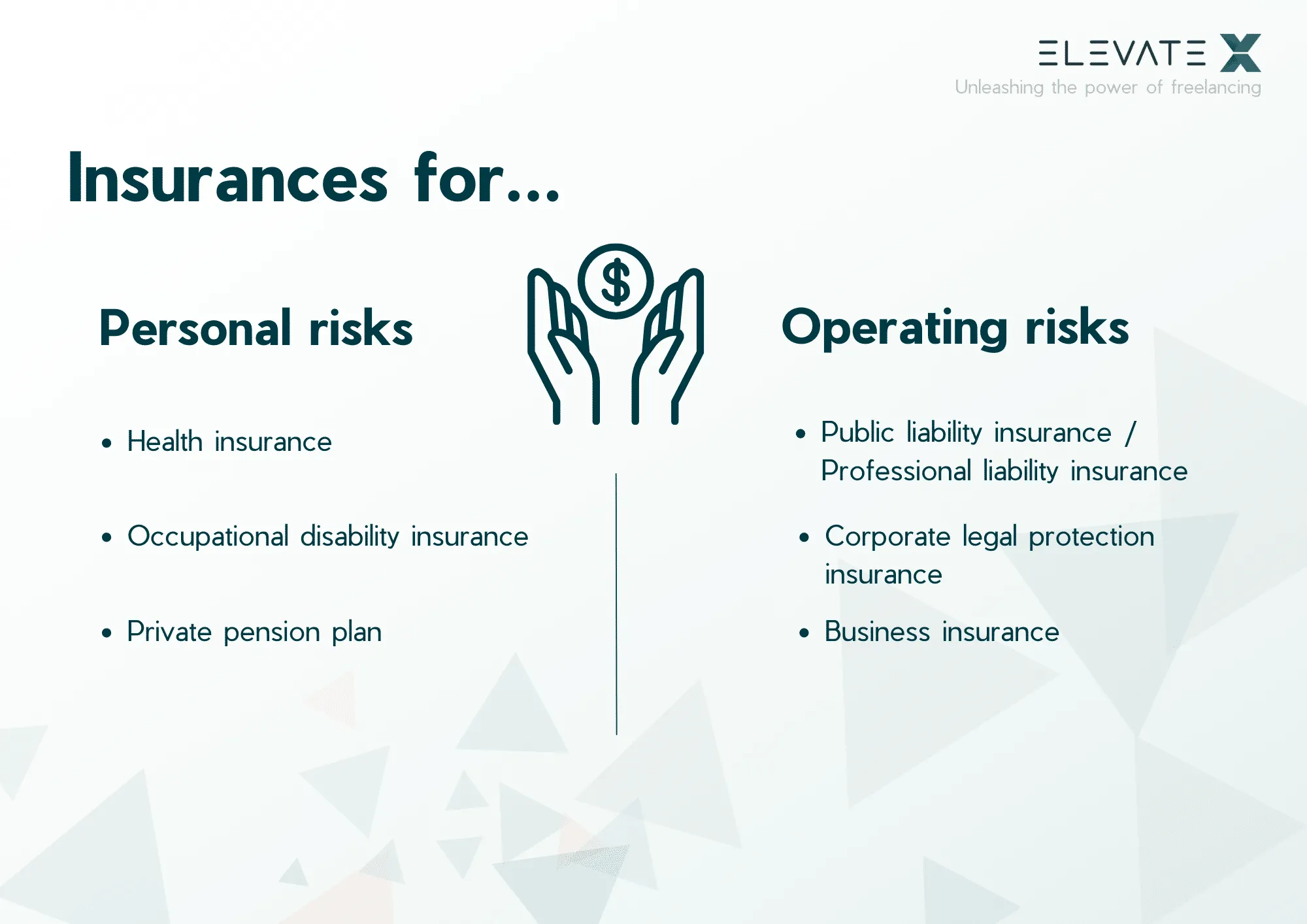
In the worst case, any of these can threaten your financial existence. Risks fall into two groups: personal (private) and business risks. You need suitable cover for both.
Covering Personal vs. Business Risks
Personal risks affect you as a person: your health, your life and your belongings. You can cover these risks with insurance such as:
- Health insurance
- Disability insurance
- Retirement provision
Business risks arise in the normal course of business, for example on your business premises or in specific activities. You can cover them with insurance such as:
- Professional liability or business liability insurance
- Company legal protection insurance
- Business insurance
Not every policy is equally important for every self-employed person. Good cover protects your most important risks without leaving you over- or underinsured.
Is It Necessary To Distinguish Between Freelancers And Self-employed Persons When It Comes To Insurance?
Self-employed, liberal professional, freelancer: the terms are often used interchangeably, but they do not mean the same thing.
“Self-employed” is the umbrella term for everyone who works on their own account. German law distinguishes between commercial traders (Gewerbetreibende) and liberal professionals (Freiberufler). Traders, such as craft and retail businesses, need a trade license and pay trade tax. Liberal professionals do not pay trade tax. Their work includes scientific, artistic and literary activities as well as higher-level services that usually require a university degree, such as those of doctors, architects, lawyers or teachers.
As a freelancer, you also work on a self-employed basis, usually for the duration of a project and often for several clients in parallel. The term is not a synonym for liberal professional, though: whether you count as a liberal professional or a trader depends on what you do. The guide to freelancer registration in Germany explains the difference.
Insurers themselves do not distinguish between these groups. There are, however, differences in which insurances are mandatory for whom and which are of secondary importance.
What Are Mandatory Insurances For Self-employed Persons?
All self-employed persons in Germany must have the following insurances:
- Health insurance
- Long-term care insurance
Germany has compulsory health insurance, regardless of your profession. As a self-employed person, you can choose between statutory and private health insurance. You can generally stay in statutory health insurance as a voluntary member if you were previously a compulsory or family member, for example when you move straight from employment into self-employment (Federal Ministry of Health). Statutory health insurance automatically includes long-term care insurance. With private health insurance, you also need private long-term care insurance.
Also check your sick pay. As a voluntarily insured self-employed person, you either pay the reduced contribution rate without sick pay or the general rate with sick pay from the 43rd day of incapacity for work (Federal Ministry of Health). An optional tariff (Wahltarif) from your health insurer can make sick pay start earlier (Section 53 SGB V). Otherwise, you bridge the first six weeks yourself, for example with savings or private daily sickness benefit insurance.
Some insurances are only mandatory for certain occupational groups. The following overview is a first orientation and not complete:
Healing professions (e.g. doctors, pharmacists, nurses, midwives):
- Professional liability insurance
- Retirement provision: midwives, as well as self-employed nurses without employees subject to social insurance, are compulsorily insured in the statutory pension scheme, doctors and pharmacists usually in their chamber’s professional pension fund (Versorgungswerk)
Craft professions and home trades:
- Pension insurance (for craftspeople entered in the register of craftspeople and for home workers)
- Accident insurance (for home workers)
Planning professions (e.g. architects, engineers):
- Professional liability insurance, depending on the federal state and activity
Education and training (e.g. teachers, educators):
- Pension insurance if you have no employees subject to social insurance
Consulting professions (e.g. lawyers, notaries, tax advisors):
- Professional liability insurance against financial losses
Artistic and journalistic professions:
- Pension, health and long-term care insurance through the Artists’ Social Insurance Fund (Künstlersozialkasse)
Self-employed with only one client:
- Pension insurance if you work permanently and mainly for one client and have no employees subject to social insurance (more on this in the next section)
There are also special rules, such as insolvency insurance for tour operators or public liability insurance for security services. Some chambers prescribe additional insurances. If in doubt, check with your chamber.
Mandatory Pension Insurance: When the Self-employed Have to Pay In
Unlike employees, self-employed people are only compulsorily insured in the statutory pension scheme in certain cases. The groups are defined in Section 2 SGB VI, the German Social Code on pensions. Compulsorily insured self-employed people usually have to register with the Deutsche Rentenversicherung within three months of starting out. Otherwise, contributions may be claimed retroactively.
Self-employed With Only One Client
This rule matters especially for IT freelancers on long projects. You are subject to compulsory pension insurance if you
- regularly employ no staff subject to social insurance, and
- work permanently and mainly for only one client.
According to the internal guidelines of the Deutsche Rentenversicherung, “mainly” means that at least five-sixths of your business income comes from that one client. A framework agreement under which individual project contracts follow one another also counts as permanent. A project limited to one year or less from the outset, with no prospect of extension, is usually not considered permanent. There is a temporary exemption for founders (see below).
If you only have one client, you should also know about false self-employment. That is a different question: whether you are self-employed at all or legally count as an employee.
When Do Self-employed Persons Not Need Compulsory Insurance?
Even if you belong to a compulsorily insured group, you do not always have to pay in (Section 2, Section 5 and Section 6 SGB VI). In some cases there is no obligation or you can apply for an exemption, for example if you
- work as a teacher, educator or nurse and regularly employ staff subject to social insurance,
- are a craftsperson who has paid compulsory contributions for at least 18 years and apply for exemption,
- work for only one client and, as a first-time founder, apply to be exempted for the first three years,
- are only marginally self-employed, meaning you regularly earn no more than the marginal earnings threshold that also applies to mini-jobs,
- draw a full old-age pension after reaching the standard retirement age.
If you are unsure, ask the Deutsche Rentenversicherung or your chamber early. That way you avoid back payments.
Retirement Provision for Freelancers: What Are Your Options?
If you are not subject to compulsory pension insurance, your retirement provision is up to you. This applies to many freelancers, for example in IT.
Is There a Mandatory Retirement Provision for the Self-employed?
Not yet. In June 2026, the pension commission (Alterssicherungskommission) recommended including self-employed people without mandatory cover, for example through a professional pension fund, in the statutory pension scheme from a cut-off date. People who are already self-employed on that date would be able to opt out. The coalition wants to implement the recommendations and aims to complete the legislative process by the end of 2026 (Federal Government). As of October 2026, however, there is neither a law nor a cut-off date. According to the Deutsche Rentenversicherung, current pension law applies until then. Keep an eye on this, especially if you are just starting out.
Statutory Pension Insurance: On Application or Voluntary
You can pay into the statutory pension scheme even if you are not required to. There are two ways:
- Compulsory insurance on application: You apply within five years of starting your self-employment. You then pay compulsory contributions for as long as you are self-employed (Section 4 SGB VI).
- Voluntary insurance: You decide how many contributions you pay and how much, in 2026 between 112.16 and 1,571.70 euros a month. You can pay the contributions for a year until 31 March of the following year (Deutsche Rentenversicherung).
The most important difference concerns the pension for reduced earning capacity (Erwerbsminderungsrente). As a rule, you need three years of compulsory contributions in the last five years to qualify (Deutsche Rentenversicherung). Voluntary contributions do not count towards this.
Basic Pension (Rürup Pension)
The basic pension (Basisrente) is particularly interesting for self-employed people who are not compulsorily insured. You pay into a private contract and later receive a lifelong monthly pension, at the earliest from age 62 (Section 10 EStG). Since 2023, you can deduct contributions in full as retirement expenses, up to a maximum amount. In 2026, the maximum is 30,826 euros for single filers and applies to all such contributions together, including contributions to the statutory pension scheme or a professional pension fund (Deutsche Rentenversicherung). You pay tax on the pension later.
The catch: your money is locked in. The entitlements cannot be inherited, transferred, used as collateral, sold or capitalized.
From 2027: Retirement Investment Account and Subsidies for the Self-employed
Most self-employed people have so far been excluded from Riester subsidies. The pension reform act (Altersvorsorgereformgesetz), which also passed the Bundesrat in May 2026, changes that. From 2027, self-employed people with business or self-employment income are generally eligible for subsidies, even if they are not compulsorily insured in the statutory pension scheme. One requirement is that you have filed a tax return (Federal Ministry of Finance).
New products include a retirement investment account (Altersvorsorgedepot) without guarantees, alongside contracts with guarantees. The basic allowance is up to 540 euros a year if you pay in 1,800 euros yourself. The new model replaces the Riester pension, and existing Riester contracts continue (Deutsche Rentenversicherung).
Private Provision Without State Support
You can also save for retirement on your own:
- Securities: With a savings plan, you automatically invest a fixed amount every month, for example in a broadly diversified ETF. Prices can fluctuate strongly, so this suits money you will not need for a long time.
- Private pension insurance: Only the guaranteed pension is certain, and surpluses may be added. Watch the costs.
- Property: Living in your own home saves rent in old age, while a rented property generates income. On the downside, property ties up a lot of capital.
Several building blocks spread the risk. The right mix depends on your income, age and risk tolerance. This overview is not investment advice. Get independent advice before making a decision.
Professional Liability Insurance for Freelancers: Do You Need It?
Professional liability insurance (Berufshaftpflicht) protects you against the financial consequences of mistakes in your work. If a client or third party claims damages, the insurer covers justified claims and defends you against unjustified ones (Section 100 VVG). Depending on the policy, it covers personal injury, property damage and financial losses.
Which Liberal Professions Must Have Professional Liability Insurance?
For some liberal professions, the law requires professional liability insurance. Lawyers must take it out under Section 51 BRAO, tax advisors under Section 67 StBerG. Professional rules also require doctors to be insured, and architects and engineers depending on the federal state.
For IT freelancers, consultants and project managers, there is usually no legal obligation. However, some clients require professional liability insurance in the contract, sometimes with a specific coverage amount. Before each project, check what your freelance contract says about liability.
Why Professional Liability Matters for IT Freelancers
IT freelancers carry a lot of responsibility and often work with sensitive data on complex projects. Insurance specialist Phillip Gohl, who focuses on liberal professions, pointed this out in a 2023 interview with ElevateX. Potential damages range from programming errors and project delays to legal disputes and financial losses.
An example: you overlook a bug in business-critical software, and the client’s system goes down. The client loses revenue and claims damages from you. Without insurance, you pay out of your own pocket. That can threaten your livelihood and damage your reputation. This is why there are special IT liability policies for freelancers.
What Does Professional Liability Insurance Cost?
There is no general answer. Costs depend mainly on the coverage amount, the scope of cover, your fee turnover and your personal risk situation. The more comprehensive the cover, the higher the premium. Compare several offers and look at the benefits, not just the price.
What to Look for When Choosing a Policy
Gohl’s tips from the interview:
- Broad cover: The policy should cover financial losses, personal injury, property damage and consequential financial losses. Because clients and requirements change, a package tailored to you is often the best fit.
- Worldwide cover: The policy should apply worldwide, because freelancers often work on international projects.
- Legal infringements: Claims arising from legal infringements should also be covered.
- Individual advice: Get advice so that the policy fits your projects and risks.
Additional Insurances For Freelancers
Some of the following insurances are mandatory for certain professions. They make sense for many freelancers.
Accident Insurance
Accident insurance protects you from the financial consequences of an accident. In the event of disability caused by an accident, it covers costs such as making your home or business premises accessible, or compensates for lost income.
Business Liability Insurance
This insurance covers property damage, personal injury and consequential financial losses caused by you, your staff or your products, or occurring on your business premises. Typical example: a client trips over a cable in your office and is injured.
Financial Loss Liability Insurance
This insurance applies if someone suffers a financial loss because of a mistake you made. It is particularly useful, and partly mandatory, for planning and consulting professions, such as architects, appraisers, collection agencies, trustees and property managers. As an IT freelancer, make sure your professional liability insurance includes financial losses.
Business Interruption Insurance (loss of earnings insurance)
This insurance continues to pay running costs such as rent or wages if your business has to stop temporarily, for example after a theft or a fire.
Legal Insurance
If a business dispute ends up in court, it can be costly. Commercial or corporate legal expenses insurance then covers the legal fees and court costs. Expert opinions and out-of-court settlements, such as mediation, are often included too.
Conclusion
As a self-employed person, you carry personal and business risks yourself. Health and long-term care insurance are mandatory for everyone, and depending on your profession also pension insurance or professional liability insurance. If you work almost exclusively for one client over a long period, check whether you are subject to compulsory pension insurance.
For IT freelancers, professional liability insurance is voluntary but one of the most important policies, because a single mistake in a project can be expensive. There is no general obligation to provide for retirement yet. Your options include the statutory pension, the basic pension, the new subsidized private pension from 2027 and unsubsidized investments. Which other insurance you need depends on your industry and personal situation. Factor these costs into your hourly rate from the start.
FAQs
What types of insurance are there for the self-employed?
Which insurances are mandatory for self-employed persons?
Do freelancers need professional liability insurance?
Do freelancers have to pay into the German statutory pension scheme?
Is there a mandatory retirement provision for the self-employed in Germany?